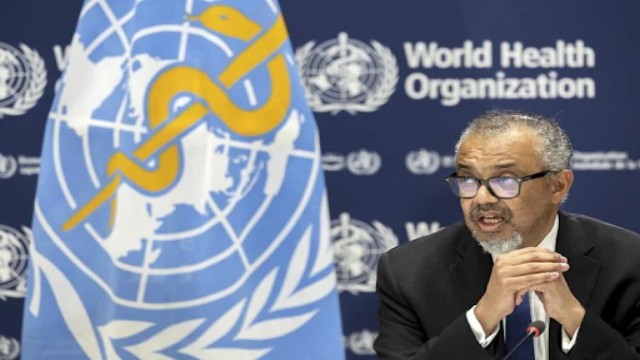
Tedros Adhanom Ghebreyesus, head of the World Health Organization (WHO), spoke at a press briefing held by the Geneva Association of United Nations Correspondents (ACANU) at the WHO headquarters in Geneva, Switzerland, on Thursday, May 1, 2025. (Photo: Salvatore Di Nolfi/Keystone via AP)
The head of the World Health Organization (WHO) has made an emotional plea to its member countries to back a $2.1 billion yearly budget, calling it a “modest” sum when compared to global military and tobacco spending. The appeal comes after the U.S., once WHO’s biggest donor, cut off all funding.
Dr. Tedros Adhanom Ghebreyesus, WHO’s Director-General, addressed the World Health Assembly and pointed out the stark contrast in global priorities. “$2.1 billion is what the world spends on military in just eight hours. It’s the cost of a stealth bomber or a fraction of tobacco advertising,” he said. “That same amount could save lives and strengthen global health.”
Though he avoided directly naming the U.S., Tedros has previously described the decision to pull funding as a mistake. The U.S. State Department confirmed it will not be participating in this year’s health assembly, underscoring a clear shift in American foreign health policy under former President Trump.
In response to the shortfall, WHO has trimmed its original two-year budget by 22%. It has already secured about 60% of the revised amount, but a $1.7 billion gap still remains. Tedros admitted that raising the rest will be difficult, especially in today’s political climate. “We’re not blind to the challenges,” he said. “But for a global agency operating in 150 countries, the budget isn’t ambitious—it’s minimal.”
Health Risks Grow as Funding Drops
The funding crisis threatens WHO’s ability to lead on urgent matters like pandemic response, vaccine distribution, and disease control. From advising on sugar limits in soda to handling polio outbreaks, WHO's work now hangs in the balance. Wealthy European nations have also scaled back contributions, shifting focus to military spending amid tensions with Russia.
Experts warn that the consequences could be devastating. Matthew Kavanagh of Georgetown University said the issue goes beyond money. “WHO’s existence is at stake. We’re watching the collapse of global cooperation at a time when lives depend on it,” he warned. “If things continue like this, millions may die needlessly.”
Treaty and Dues on the Table
Despite the tension, the World Health Assembly is pushing ahead with two key proposals. First, member states are expected to approve a 20% increase in their mandatory contributions to reduce dependence on voluntary donations. Second, a proposed pandemic treaty aims to ensure equitable access to vaccines and medicines during future outbreaks.
The treaty would also guarantee that countries sharing virus samples get a fair share of the resulting treatments. WHO would receive up to 20% of vaccines and medicines to distribute in low-income countries. Still, without U.S. backing or enforcement mechanisms, questions remain about the treaty’s effectiveness.
“This is a defining moment,” Tedros said. “The decisions made this week could shape global health for generations.”
Shake-Up and Protests Surround WHO
As the WHO tries to stay afloat, internal reforms are underway. Tedros recently announced a reshuffle of top management, including the departure of longtime emergencies chief Dr. Michael Ryan. WHO is also cutting expenses and reviewing its staffing due to a $500 million salary gap.
Outside the Geneva assembly, protests added to the drama. Activist group CitizenGo rallied against the pandemic treaty, accusing the WHO of grabbing more power post-COVID. The group displayed a large banner targeting WHO leadership and key donors like Bill Gates, claiming the treaty would strip away freedoms rather than fix past mistakes.
As debate rages inside and outside the assembly hall, WHO stands at a crossroads. Its survival may depend on whether the global community is willing to fund not just an agency—but a lifeline for millions.