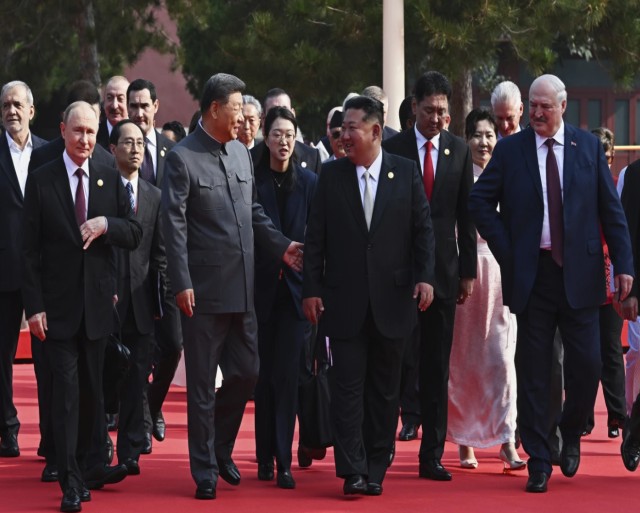
Front from left, Russian President Vladimir Putin, Chinese President Xi Jinping, North Korean Leader Kim Jong Un and Belarusian President Alexander Lukashenko arrive at a military parade to commemorate the 80th anniversary of Japan’s world war 2 surrender in Beijing.
China showcased its growing global influence with a grand military parade in Beijing. The event marked the 80th anniversary of World War II’s end and was attended by leaders from nearly two dozen countries. President Xi Jinping stood at the center of the gathering, flanked by powerful allies.
Russian President Vladimir Putin and North Korean leader Kim Jong Un, who made a rare foreign visit, joined Xi on the viewing platform overlooking Tiananmen Square. Together, they watched thousands of troops and modern military hardware parade past. Analysts see this moment as more than ceremonial. It signaled solidarity among China’s partners and a united challenge to the U.S.-led international order.
A Parade of Global Power
The guest list reflected Beijing’s growing role among nations in the Global South and beyond. While the United States, European powers, Japan, South Korea, and India skipped the event, many countries aligned with or sympathetic to China showed up in full support.
Xi’s parade became both a military showcase and a diplomatic statement.
U.S. Adversaries Show Support
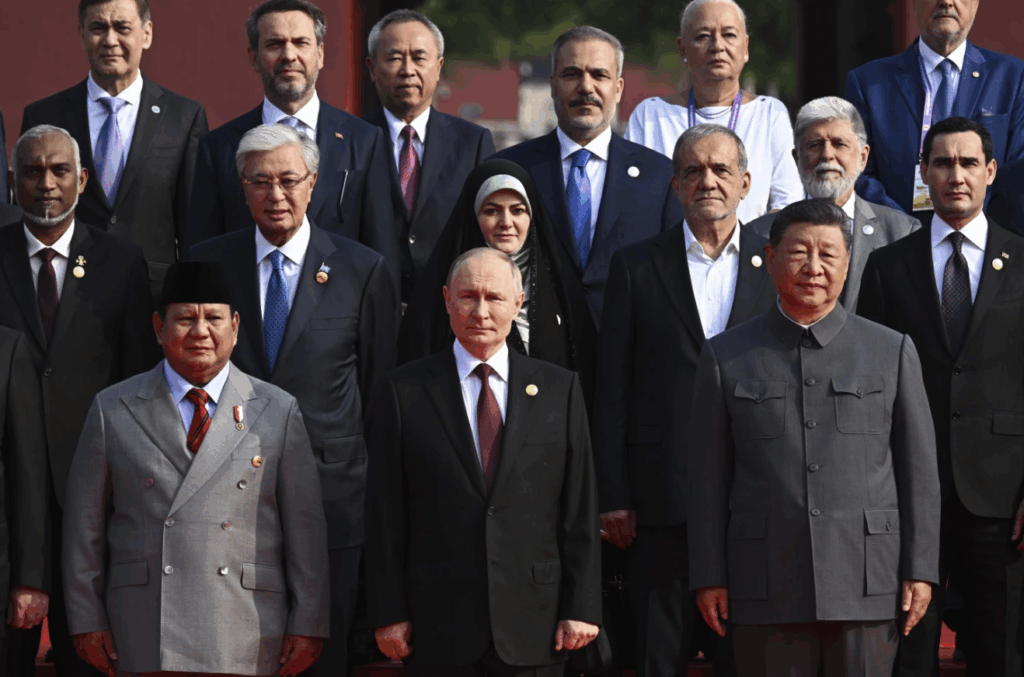
Among the most notable guests were leaders often at odds with Washington. Iranian President Masoud Pezeshkian joined the event, along with Belarusian President Alexander Lukashenko. Lukashenko, a close ally of Moscow, stood beside Kim during the group photo.
The chemistry between Putin, Kim, and Xi drew particular attention. The three leaders engaged in friendly conversation while ascending the viewing platform, a striking image that observers described as a symbolic challenge to U.S. dominance.
Asia and Africa at the Forefront
China also drew support from key Asian and African nations. Indonesian President Prabowo Subianto, despite initial hesitation due to domestic protests, ultimately joined the parade. He stood alongside Southeast Asian leaders such as Cambodia’s King Norodom Sihamoni, Vietnamese President Luong Cuong, and Malaysian Prime Minister Anwar Ibrahim.
Myanmar’s military ruler, Senior Gen. Min Aung Hlaing, also attended, underlining Beijing’s close ties with its neighbor.
South Asia and Central Asia were well-represented too. Pakistani Prime Minister Shehbaz Sharif and Kazakhstan’s President Kassym-Jomart Tokayev made appearances, reinforcing China’s regional partnerships.
From Africa, Zimbabwean President Emmerson Mnangagwa stood among the honored guests, reflecting China’s deepening footprint on the continent.
Few European Leaders Attend
While Asia and Africa had a strong presence, Europe remained largely absent. Most Western leaders skipped the parade in a clear political message.
Still, Serbia’s pro-Russia President Aleksandar Vucic and Slovak Prime Minister Robert Fico joined the event. Their attendance highlighted Europe’s divisions over ties with Beijing and Moscow.
Adding a historical touch, former Romanian prime ministers Adrian Năstase and Viorica Dăncilă joined the group photo, though most current European leaders stayed away.
A Strategic Message to the World
The Beijing military parade was more than a commemoration. It was a stage where China displayed both its military strength and diplomatic reach. By hosting leaders from Asia, Africa, and parts of Europe, Xi underscored Beijing’s growing role in shaping a multipolar world.
The joint appearance of Xi, Putin, and Kim became the centerpiece of the event. For many, it was a vivid picture of a shifting global order where China positions itself as the hub of resistance to U.S. influence.