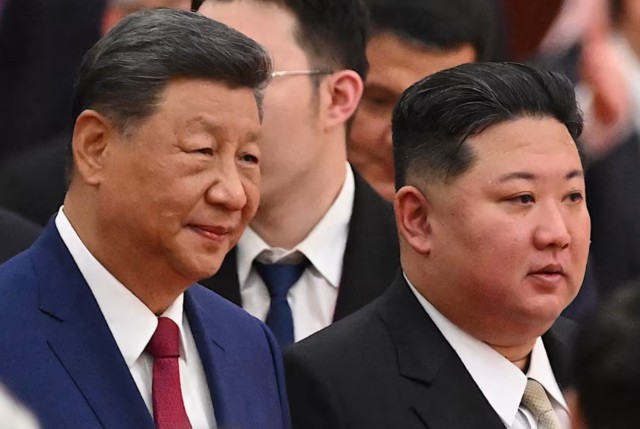
Chinese leader Xi Jinping and North Korean leader Kim Jong Un arrive for a reception in the Great Hall of People, following a military parade marking the 80th anniversary of the end of World War II, in Beijing on September 3, 2025.
Chinese President Xi Jinping and North Korea’s Kim Jong Un have pledged to strengthen their alliance. The summit came a day after both leaders stood with Russian President Vladimir Putin at a grand military parade in Beijing.
The rare three-way display underscored the growing alignment of China, North Korea, and Russia against Western influence.
Xi and Kim Reaffirm Friendship
Xi and Kim met at Beijing’s Great Hall of the People, marking their first formal summit in six years. Chinese state media reported that Xi hosted Kim for tea and dinner after their talks.
The two leaders emphasized that their friendship would remain unchanged “no matter how the international situation changes.” Xi described the nations as “good neighbors, good friends, and good comrades bound by shared destiny.”
Kim assured Xi that North Korea would “invariably support” China in protecting its sovereignty and development interests, according to North Korean media.
Shift in Diplomatic Tone
One striking element of the meeting was the absence of any reference to “denuclearization of the Korean Peninsula” in China’s official readout. This marks a break from previous summits, where the issue was consistently raised.
Analysts see this as a signal that Beijing may be tacitly accepting Pyongyang’s nuclear power status. North Korea’s weapons program has made it one of the most heavily sanctioned nations in the world, but rising tensions with the West have made both China and Russia less critical of it.
North Korea Gains Diplomatic Ground
Experts believe Kim secured a diplomatic victory by avoiding criticism over his nuclear arsenal. Wu Qiang, a Beijing-based analyst, said the silence on denuclearization effectively legitimized North Korea’s nuclear status.
South Korean experts also noted that the summit’s tone could embolden Pyongyang to expand its nuclear capabilities. Professor Lim Eul-chul of Kyungnam University said China’s support might be interpreted as tacit approval of North Korea’s nuclear posture.
Parade of Power With Putin
Xi, Kim, and Putin appeared together at China’s military parade marking the 80th anniversary of World War II’s end. This was their first joint public appearance, symbolizing a united front against Western powers.
Leaders from 26 nations attended, but only Putin and Kim were given the honor of tea and a banquet with Xi afterward. Russian media reported that Putin was even hosted at Xi’s residence in Zhongnanhai, highlighting the closeness of their ties.
For Kim, who leads a heavily sanctioned state, the event offered a rare chance to share the global stage with influential leaders.
North Korea’s Alliance With Russia
North Korea’s growing alignment with Russia also loomed over the summit. Last year, Kim and Putin signed a mutual defense pact pledging military support if either nation is attacked.
Putin has relied on North Korean weapons and troops to sustain his war in Ukraine. During their recent meeting, Putin praised North Korean forces and invited Kim to visit Russia again.
China has officially dismissed the pact as a “bilateral matter,” but analysts believe Beijing views the Moscow-Pyongyang partnership with unease. Closer Russia-North Korea ties could complicate East Asia’s fragile security balance and reduce China’s leverage over Kim.
Beijing’s Balancing Act
China remains North Korea’s largest trade partner, providing more than 95% of its foreign trade and crucial economic support. The two nations also share a mutual defense treaty dating back to 1961.
Yet, Pyongyang’s rapid nuclear buildup has often made it a liability for Beijing. Analysts say China is wary of North Korea gaining advanced military technology from Russia, which could further destabilize the region.
Edward Howell, a lecturer at Oxford University, said China is not openly angry about the new alliance but remains uneasy. “Beijing wants to retain influence over the Korean Peninsula, while Pyongyang will continue extracting benefits from both Moscow and Beijing,” he noted.
The Xi-Kim summit signals a renewed closeness between China and North Korea, even as Pyongyang builds stronger ties with Russia. The absence of denuclearization from their talks highlights shifting regional dynamics, raising concerns among Western and Asian allies.
For now, the emerging partnership of Xi, Kim, and Putin appears determined to challenge Western dominance and reshape the global order.