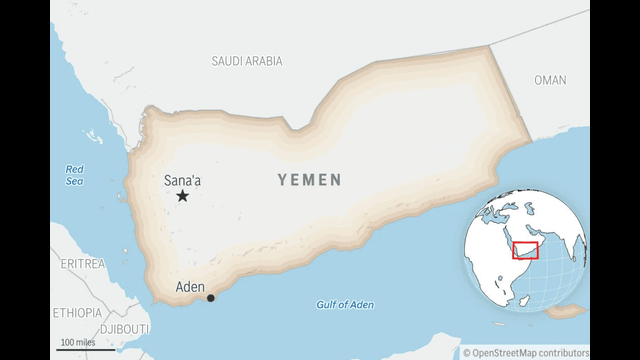
This is a locator map for Yemen with its capital, Sanaa.
A major political rupture has shaken Yemen’s anti-Houthi camp.
An alliance fighting the Houthis rebels announced the expulsion of a powerful separatist leader.
The council also said the leader now faces serious treason charges.
The move deepens divisions within forces once united against a common enemy.
Expulsion Marks Sharp Escalation
The Yemen anti-Houthi council, known as the Presidential Leadership Council, confirmed the decision on Wednesday.
It said Aidarous al-Zubaidi had been removed from its ranks.
Al-Zubaidi leads the Southern Transitional Council, or STC.
The STC has long pushed for southern Yemen’s independence.
The announcement was carried by SABA news agency.
The agency is controlled by anti-Houthi authorities.
Officials described the charges against al-Zubaidi as treason.
They accused him of undermining national security.
Saudi Arabia Issues Separate Claims
Saudi Arabia released its own statement hours earlier.
It said al-Zubaidi was expected to travel to the kingdom for talks.
Those negotiations were meant to discuss southern Yemen’s political future.
However, Saudi officials said the trip never happened.
According to the Saudi-led coalition, al-Zubaidi skipped the scheduled flight.
Other STC officials reportedly boarded the plane.
Al-Zubaidi stayed behind.
Allegations of Armed Mobilization
Saudi coalition spokesperson Maj. Gen. Turki al-Malki gave further details.
He said intelligence reports raised immediate alarm.
The reports claimed al-Zubaidi mobilized armed forces instead of traveling.
Saudi officials alleged the movement included armored vehicles and combat equipment.
They also cited heavy and light weapons.
Large amounts of ammunition were reportedly involved.
Soon after, al-Zubaidi was said to have fled.
Al-Malki said his destination remains unknown.
The Yemen anti-Houthi council echoed these concerns.
Both sides framed the actions as a direct threat.
Silence From the Southern Transitional Council
The Southern Transitional Council has not issued a response.
It has remained silent on the expulsion and treason accusations.
There was also no immediate comment on Saudi Arabia’s claims.
This silence has fueled further speculation.
The STC has previously accused rivals of political manipulation.
It argues it represents southern interests ignored for decades.
Yet the latest developments place the group under intense pressure.
Recent Clashes and Airstrikes
Tensions between allies have been building for weeks.
Saudi Arabia has recently bombed STC-linked positions.
It also struck what it described as an Emirati weapons shipment.
These actions followed sharp warnings from anti-Houthi authorities.
They demanded foreign-backed groups withdraw from contested areas.
After this pressure, the United Arab Emirates made an announcement.
The UAE said it had withdrawn its forces from Yemen.
Strain Between Regional Powers
The Yemen conflict is now straining regional relationships.
Saudi Arabia and the UAE are neighbors and longtime partners.
Both are key players on the Arabian Peninsula.
However, their interests have increasingly diverged.
Economic rivalry has added to political tension.
Disagreements over influence in the Red Sea region persist.
Yemen has become a major fault line between the two allies.
Shared Enemy, Divided Coalition
Despite the rift, both countries oppose the Houthi rebels.
The Houthis are backed by Iran.
They have controlled Yemen’s capital, Sanaa, since 2014.
This shared threat once unified the coalition.
Now, internal fractures dominate the narrative.
The Yemen anti-Houthi council faces a credibility test.
Its ability to manage allies is under scrutiny.
The expulsion of al-Zubaidi signals a turning point.
As the conflict evolves, unity within the anti-Houthi camp appears increasingly fragile.