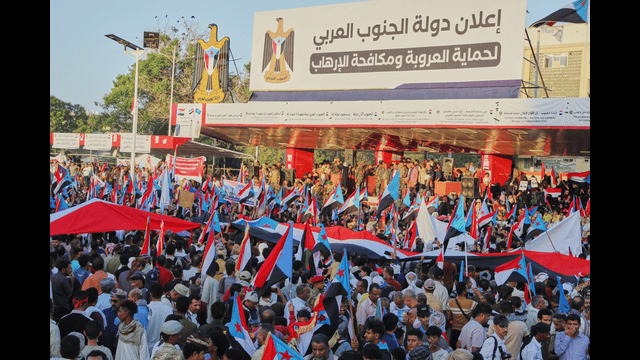
Supporters of STC, a coalition of separatist groups seeking to restore the state of Youth Yemen.
Saudi Arabia has urged Yemen’s southern separatists to withdraw from two key governorates, warning of rising tensions within the anti-Houthi coalition. The call highlights growing fractures inside the alliance fighting Iran-backed Houthi rebels, even as Yemen remains trapped in a devastating war.
Saudi Warning Raises Coalition Tensions
On Thursday, Saudi Arabia publicly asked Emirati-backed separatists to leave Yemen’s Hadramout and Mahra governorates. The appeal targeted the Southern Transitional Council (STC), a powerful force seeking an independent South Yemen.
Riyadh supports Yemen’s internationally recognized government and its National Shield Forces. The STC’s recent moves risk confrontation within a coalition already under pressure.
Saudi Arabia’s Foreign Ministry said the separatists’ actions caused “unjustified escalation” and harmed Yemeni interests. It urged all factions to exercise restraint and protect stability.
Separatist Advance Sparks Mediation Efforts
The Southern Transitional Council moved forces into Hadramout and Mahra earlier this month. Saudi officials confirmed mediation talks are ongoing.
The goal is clear. STC fighters should return to previous positions and hand camps to government-aligned forces. Saudi Arabia said these efforts remain active.
Local authorities in Hadramout welcomed the Saudi statement. They also called for the separatists’ withdrawal from the governorate.
South Yemen Flag Returns to Streets
Supporters of the STC have increasingly raised the South Yemen flag, recalling the former state that existed until 1990.
Demonstrations took place in Aden, the southern port city, backing renewed calls for secession. Aden currently hosts Yemen’s internationally recognized government.
The Houthis seized Sanaa in 2014, forcing the government south. Since then, Aden has remained a political center for anti-Houthi forces.
Saudi-Emirati Relations Under Pressure
The separatist advance has strained relations between Saudi Arabia and the United Arab Emirates. Both nations are close allies and OPEC members.
However, rivalry for regional influence and business has grown in recent years. Yemen now adds another point of friction.
Tensions also mirror divisions in Sudan, where Riyadh and Abu Dhabi back opposing sides in another Red Sea conflict.
Yemen War’s Heavy Toll
The Houthis captured Sanaa in September 2014 and pushed the government into exile. A Saudi-led coalition entered the war in 2015.
Years of fighting have devastated Yemen. More than 150,000 people have been killed. Millions face hunger and displacement.
Iran denies arming the Houthis. Yet Iranian-made weapons have repeatedly been intercepted, despite a U.N. embargo.
Houthis Bury Senior Commander
As political tensions rose, the Houthis held funerals in Sanaa for four fighters. Among them was Maj. Gen. Zakaria Abdullah Yahya Hajar.
Analysts identified Hajar as the group’s top missile and drone commander. He was reportedly targeted in U.S. airstrikes in March.
The Houthis gave no details about his death. However, U.S. officials previously referenced a strike aimed at a senior missile figure.
Red Sea Attacks Raise Global Risks
The Houthis have attacked hundreds of ships in the Red Sea corridor, citing the Israel-Hamas war. The assaults disrupted global trade routes.
While attacks have slowed recently, many vessels still avoid the area. Shipping continues around Africa’s Cape of Good Hope.
Further instability in Yemen could again draw in the United States, which has conducted multiple strikes against Houthi targets.
Growing Fears of Wider Chaos
The Houthis have also detained dozens of U.N. and aid workers, accusing them of espionage. The allegations remain unproven.
Saudi Arabia now faces a delicate challenge. It must contain separatist ambitions while preventing deeper coalition fractures.
With diplomacy under strain and violence ongoing, Yemen’s fragile balance faces yet another dangerous test.