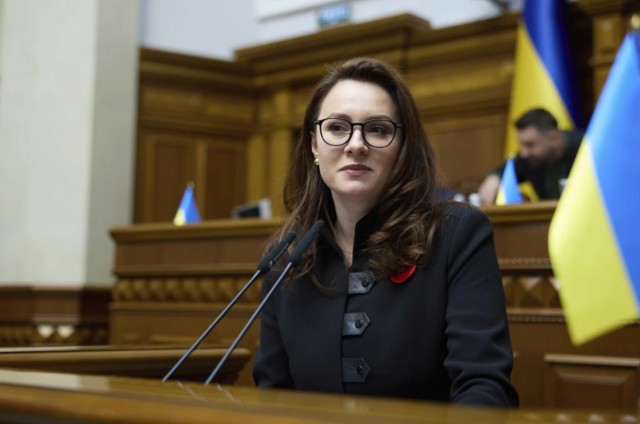
Vice Prime Minister and Minister of Economy of Ukraine Yuliia Svyrydenko speaks in the Ukrainian Parliament in Kyiv, Ukraine, Thursday, May 8, 2025.
In a decisive move to strengthen Ukraine’s wartime leadership, President Volodymyr Zelenskyy has appointed Yulia Svyrydenko as the country’s new Prime Minister. Her appointment comes at a crucial juncture when the nation is grappling with the ongoing Russian invasion and pressing defense needs.
A Strategic Choice for a War-Torn Nation
Svyrydenko, Ukraine’s former economy minister, replaces Denys Shmyhal, the country’s longest-serving prime minister. With her elevation, Ukraine marks its first head of government change since Russia’s full-scale invasion in 2022. Her experience as a skilled diplomat, especially with Western powers and the United States, is central to her selection.
She played a key role in negotiating a landmark U.S.-Ukraine partnership focused on developing Ukraine’s critical mineral resources. This deal aims to align U.S. strategic interests with Ukraine’s long-term security and economic resilience.
Clear Goals for Ukraine’s Defense Future
Svyrydenko, 39, wasted no time outlining her urgent priorities. In a post on X (formerly Twitter), she stated, “War leaves no room for delay. We must act swiftly and decisively.” She listed three major goals for her first six months:
- Ensure a reliable supply of resources to the Ukrainian army
- Expand domestic weapons manufacturing
- Strengthen the technological capabilities of Ukraine’s defense sector
Her message underscores Ukraine’s intention to take more control of its own defense efforts amid growing global fatigue over prolonged conflicts.
Shmyhal Transitions to Defense Role
Denys Shmyhal, who served as prime minister since March 2020, has stepped down to take over as Ukraine’s new defense minister. He replaces Rustem Umerov, whose tenure faced criticism over mismanagement despite attempts at reform.
Shmyhal’s reassignment signals a strategic shift. With the war entering a prolonged phase, Ukraine is focusing on enhancing its internal arms production and defense systems. His experience and steady leadership are expected to bring more discipline and clarity to the defense ministry.
Cabinet Shuffle Aims to Reignite Public Confidence
The reshuffle includes other significant moves. President Zelenskyy has nominated Olga Stefanishyna, the former minister for European integration, to become Ukraine’s new ambassador to the United States. In the interim, she will serve as a special representative tasked with expanding U.S.-Ukraine cooperation.
Though Zelenskyy is bringing in new titles and roles, the core leadership remains largely the same. Many Ukrainians view this as continuity rather than transformation, reflecting the president’s reliance on proven, experienced hands during an unpredictable war.
U.S. Ties Tighten with Military Support and Diplomacy
Earlier this week, U.S. President Donald Trump approved a plan that could channel billions of dollars’ worth of American military equipment to Ukraine. Under this strategy, European allies would purchase U.S. arms—including advanced air-defense systems—and transfer them to Ukrainian forces.
This support follows recent intensified Russian strikes. Zelenskyy, addressing the Ukrainian parliament, acknowledged the difficulty of keeping global attention focused. “There are too many wars and crises erupting across the world,” he said. “Ukraine must now rely more on its own strength.”
A Hard Deadline for Russia
In a bold warning, Trump issued an ultimatum to Russian President Vladimir Putin. If Putin does not agree to a ceasefire within 50 days, the U.S. will impose heavy tariffs on countries that continue buying Russian oil. This move is designed to undercut Russia’s financial engine and push it toward negotiation.
A Leadership Built for Resilience
With Yulia Svyrydenko at the helm and Denys Shmyhal guiding defense, Ukraine’s new leadership structure is built for both resilience and reform. As the war enters a critical stage, Zelenskyy’s strategy appears focused on balancing continuity in governance with renewed momentum in diplomacy and defense.
Whether this cabinet reshuffle translates into tangible gains remains to be seen. But one thing is clear: Ukraine is reorganizing not just to survive—but to regain control of its future.