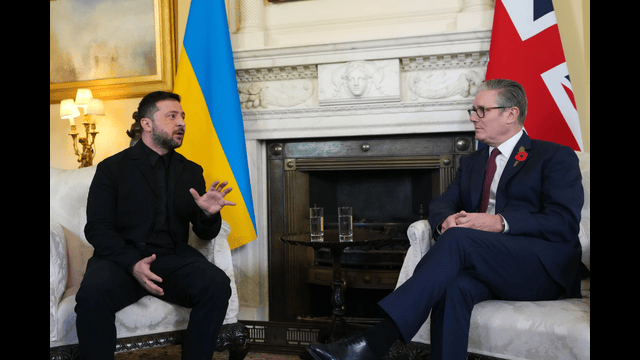
Britain’s Prime Minister Keir Starmer welcomes Ukraine’s President Volodymyr Zelenskyy to 10 Downing Street in London, Friday, Oct. 24, 2025 for bilateral talks and a later meeting of the so-called “coalition of the willing”.
Ukrainian President Volodymyr Zelenskyy has urged the United States to broaden sanctions on Russia’s oil industry and supply Kyiv with long-range missiles to counter Moscow’s ongoing aggression.
Zelenskyy made his appeal during a high-level meeting in London with European leaders, where discussions focused on strengthening Ukraine’s defenses and intensifying pressure on Russian President Vladimir Putin.
Zelenskyy Pushes for Wider Oil Sanctions
During a press conference at the U.K. Foreign Office Zelenskyy praised U.S. President Donald Trump’s recent sanctions on Russia’s Rosneft and Lukoil but said the measures must go further.
“Sanctions should target all Russian oil companies, not just a few,” he stressed. “We must increase pressure on Russia’s energy lifeline.”
He also revealed that Ukraine has been conducting its own drone and missile operations to disrupt Russia’s oil infrastructure. Zelenskyy described these efforts as part of a broader strategy to weaken Moscow’s war funding.
London Meeting Focuses on Ukraine’s Defense and Power Security
The London summit, hosted by British Prime Minister Keir Starmer, brought together more than 20 European leaders. The gathering sought to coordinate efforts to protect Ukraine from future Russian offensives if a ceasefire takes hold.
Discussions centered on several key areas — securing Ukraine’s power grid ahead of winter, strengthening air defenses, and considering long-range missile support. Zelenskyy again pressed the U.S. to provide Tomahawk missiles, a request that Trump is reportedly considering.
Starmer reaffirmed the U.K.’s commitment to standing by Ukraine. “Putin’s demands for Ukrainian land are unacceptable,” he said. “He has failed to seize it by force, and he won’t gain it through coercion.”
Putin’s Stance Frustrates the West
Putin has resisted calls to negotiate a peace deal, maintaining that Russia’s invasion was justified. Western leaders, however, view his stance as an obstacle to ending Europe’s bloodiest conflict in decades.
NATO Secretary-General Mark Rutte noted that while Putin’s ambitions remain unchanged, “he is running out of money, troops, and ideas.”
Despite mounting international pressure, Russia continues to exploit loopholes in Western sanctions to sustain its war economy.
Russian Envoy Visits Washington Amid Tensions
In a surprising development, Russian investment envoy Kirill Dmitriev arrived in the U.S. for meetings with American officials. Dmitriev said his visit was pre-planned and came at the invitation of Washington.
He is expected to meet U.S. envoy Steve Witkoff to discuss issues ranging from the Ukraine conflict to the release of American detainees in Russia. Dmitriev has long served as a key link between the Kremlin and U.S. administrations.
Western Allies Mull a ‘Reassurance Force’
European allies are exploring plans to form a “reassurance force” to safeguard Ukraine in the long term. The proposal aims to provide air and naval support, training, and surveillance — without deploying Western troops directly into Ukraine.
U.K. Defense Secretary John Healey said the envisioned force would “secure the skies, the seas, and support Ukrainian defense operations.”
However, with the war nearing its fourth year and peace talks still distant, the initiative remains largely conceptual.
Fighting Intensifies Across Ukraine
While diplomatic discussions continue, the conflict on the ground shows no sign of easing. Russia’s Defense Ministry claimed it has captured ten Ukrainian villages in the Donetsk region over the past week, inching closer to Ukraine’s key defensive positions.
Moscow also reported downing more than 100 Ukrainian drones overnight, with debris damaging homes and infrastructure. In Moscow, three drones heading toward the city were intercepted, temporarily disrupting flights at two airports.
Ukrainian officials said Russian attacks on Kherson killed two civilians and injured 22 others. In Kharkiv, glide bombs injured six people and destroyed several homes.
For the first time, Russia used glide bombs on Odesa, a move Ukrainian officials called “a new and serious threat.” These bombs, cheaper than missiles but carrying heavier payloads, mark a dangerous shift in Russia’s assault tactics.
The Road Ahead
As winter looms, Ukraine faces growing energy and security challenges. Zelenskyy’s call for stronger U.S. sanctions and advanced weaponry reflects Kyiv’s urgency to sustain its defense.
Despite Western backing, the war remains locked in a deadly stalemate — one that continues to test global resolve and Ukraine’s resilience.