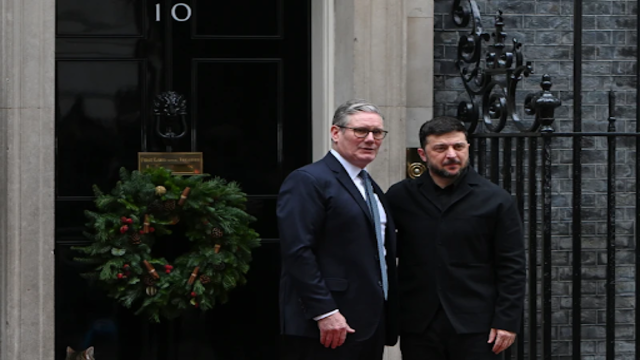
Britain’s Prime Minister Keir Starmer greets Ukrainian President Volodymyr Zelenskyy, on the doorstep of 10 Downing Street, London, Monday, Dec. 8, 2025. Associated Press
Ukrainian President Volodymyr Zelenskyy has once again made his position clear: Ukraine will not surrender any territory to Russia. His firm stance comes as the U.S. pushes Kyiv to consider concessions and as he travels across Europe seeking stronger backing for Ukraine’s defense and its future security.
Speaking to reporters late Monday, Zelenskyy emphasized that giving up land is not an option under Ukrainian law, international law, or basic moral principles. His message remained consistent as he engaged with European leaders to reinforce unity against Russia’s ongoing aggression.
Zelenskyy Defies U.S. Pressure Over Territory
Zelenskyy’s comments followed an interview in which former U.S. President Donald Trump urged Ukraine to “play ball” and accept a proposal involving territorial concessions. Trump argued that Russia currently has the “upper hand,” suggesting Kyiv must give up parts of the Donbas region.
U.S. and Ukrainian officials recently wrapped up three days of negotiations, but no agreement was reached. Zelenskyy confirmed that three documents remain under discussion — a 20-point framework, a security guarantees plan, and a recovery proposal. Ukraine will submit an updated version to Washington on Wednesday.
Despite pressure, Zelenskyy insisted that the Ukrainian government has “no right” — legal or moral — to hand over territory occupied by Russia.
Diplomatic Push in Europe
Zelenskyy continued his diplomatic tour with a visit to Rome, where he met Italian Premier Giorgia Meloni. Their talks focused on the peace process, long-term European security, and strategies to push Russia toward meaningful negotiations.
Italy underlined the importance of European-U.S. unity, stressing that any peace solution must safeguard the continent from future Russian aggression. Discussions included building robust security guarantees to prevent another invasion.
Earlier, Zelenskyy met Pope Leo XIV at Castel Gandolfo. The pope called for sustained diplomatic efforts and a “just, lasting peace,” maintaining the Vatican’s neutral position while offering solidarity to what it calls the "martyred people of Ukraine."
The diplomatic tour also included high-level talks in London with British Prime Minister Keir Starmer, French President Emmanuel Macron, and German Chancellor Friedrich Merz. Their discussions centered on strengthening Ukraine’s negotiating position amid rising tension and impatience in Washington.
European Leaders Back Kyiv’s Position
European leaders reiterated their commitment to Ukraine’s sovereignty. Starmer called the current phase of peace talks “critical,” while Merz expressed caution about aspects of the U.S. proposals, signaling concerns over Russia’s intentions.
Europe’s priority remains securing a just ceasefire backed by strong guarantees from both Europe and the U.S. to deter future attacks. Trump has yet to publicly offer such guarantees, deepening European skepticism.
Rising Tensions as Both Sides Launch Drone Strikes
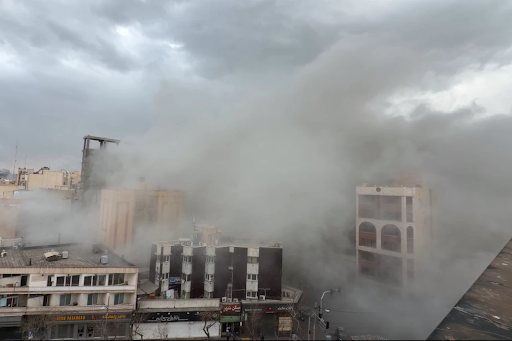
The conflict intensified overnight as Russia launched 110 drones across Ukraine. Air defenses intercepted 84, but 24 hit critical infrastructure, triggering emergency blackouts in several regions. Ukraine’s national energy operator warned of severe strain on the grid as winter conditions worsen.
Ukraine responded by continuing its drone strikes on Russian territory. Russian officials reported the destruction of 121 drones across multiple regions, including the Crimean Peninsula. One attack damaged buildings in Chuvashia and injured nine people.
A Ukrainian drone operation also ignited a major fire at a liquefied gas terminal in Temryuk, reportedly burning more than 20 storage tanks for three days.
Humanitarian Crisis Deepens
The U.N. warned that only 65% of the funds needed for Ukraine’s winter response plan have been raised. This shortfall is forcing cuts to critical services, including heating assistance, cash aid, and protection for vulnerable populations. Officials fear many families will face freezing conditions without support.
In a separate development, the U.K. confirmed the first British servicemember death in Ukraine after a training-related accident, highlighting ongoing international involvement in supporting Ukrainian forces.
Elections and Security Concerns
Trump renewed his call for Ukraine to hold a presidential election despite martial law. Zelenskyy responded by requesting international help to ensure election security and suggested balloting could take place within 60–90 days if conditions permit. However, he has consistently argued that elections should only occur once a ceasefire is secured.
A Defining Moment for Ukraine
Zelenskyy and his European allies accuse Russia of dragging out peace talks to prolong its invasion. With rising battlefield pressure, intensified air attacks, and growing diplomatic friction, Ukraine faces a decisive period.
Yet the Ukrainian president remains resolute: no land will be ceded, and Ukraine will continue pushing for a peace agreement that protects its sovereignty, its people, and its long-term security.