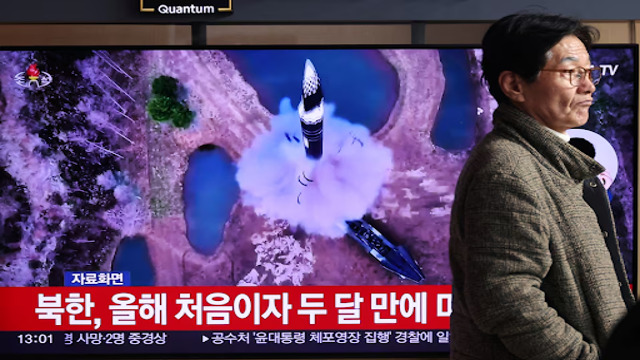
A man walks by a television showing a news report about North Korea launching a ballistic missile into the sea off its east coast, in Seoul, South Korea, on January 6, 2025. Reuters
North Korea launched an intermediate-range ballistic missile into the sea on Monday, just as U.S. Secretary of State Antony Blinken was visiting Seoul. This missile test took place during a time of political unrest in South Korea.
South Korea's military reported that the missile was fired eastward around noon (0300 GMT), shortly after Blinken had met with South Korea’s Acting President, Choi Sang-mok. In that meeting, Blinken reinforced the United States' firm security commitment to South Korea, urging a strong joint defense to prepare for any further provocations from North Korea.
This missile launch comes at a particularly tense time for South Korea, as Acting President Choi is currently standing in for President Yoon Suk Yeol, who was impeached after his declaration of martial law on December 3. The declaration led to his suspension from duties on December 14, creating a period of political instability in the country.
The missile fired on Monday marked North Korea's first missile test since November 5, when it launched several short-range missiles from its east coast. While it was unclear exactly what kind of missile was used in Monday's test, previous tests of North Korea’s intermediate-range ballistic missiles (IRBMs) included new solid-fuel technology. These missiles also featured a hypersonic glide vehicle, which is designed to maneuver and evade missile defenses.
North Korea has been working to develop solid-fuel missiles for all ranges, which have a number of advantages over liquid-fuel missiles. Solid-fuel missiles do not require immediate fueling before launch, making them easier and safer to handle. They are also harder to detect and more difficult to intercept, as they need less logistical support.
North Korea’s missile tests have been a growing concern for both South Korea and the U.S., as they challenge regional stability and increase tensions on the Korean Peninsula. The missile launch also serves as a reminder of the persistent threats posed by Pyongyang’s missile and nuclear programs.
As the situation in South Korea remains politically charged, the international community continues to watch closely. Blinken’s visit was intended to reaffirm the U.S.'s support for South Korea in the face of these growing challenges, especially as tensions with North Korea continue to rise.
The missile launch on Monday demonstrates that North Korea remains determined to advance its missile capabilities, despite global pressure and sanctions. With both military and political challenges at play, the coming weeks could see further developments in this tense geopolitical situation.