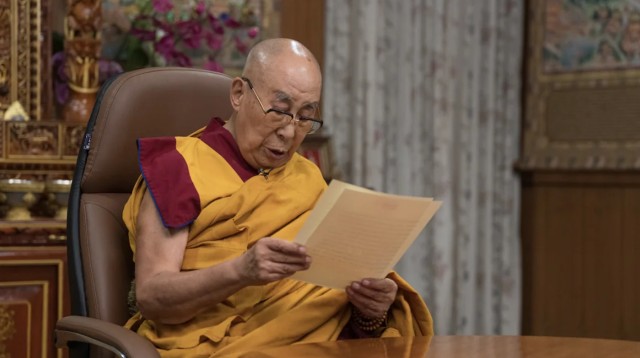
Tibetan spiritual leader the Dalai Lama speaks in a previously-recorded video message at the start of the 15th Tibetan Religious Conference in Dharamshala, India, on July 2, 2025.
In a landmark statement ahead of his 90th birthday, the Dalai Lama has declared that the centuries-old institution of the Dalai Lama will continue after his death. This announcement directly challenges China's long-standing claims over control of the succession process.
The spiritual leader made this statement through a pre-recorded video address to Tibetan Buddhist leaders gathered in Dharamshala, India — his place of exile since 1959 after fleeing a failed uprising against Chinese rule.
Dalai Lama Confirms a Successor Will Follow
“I am affirming that the institution of the Dalai Lama will continue,” said the 14th Dalai Lama, Tenzin Gyatso. He emphasized that this decision follows repeated requests from Tibetans and followers of Tibetan Buddhism around the world.
He also stated that the Gaden Phodrang Trust, the official body representing his office, will hold the exclusive right to recognize his reincarnation. “No one else has any such authority to interfere,” he declared, a clear reference to China’s attempts to insert itself into the process.
Tradition Will Guide the Search
While he didn’t detail how the selection would unfold, he confirmed it would follow Tibetan Buddhist traditions. This statement reiterates his earlier stance that, around the age of 90, he would consult senior monks and the Tibetan people to assess whether the Dalai Lama institution should continue.
Now, the answer is clear: it will endure.
Beijing Pushes Its Own Agenda
In response, a Chinese Foreign Ministry spokesperson reiterated Beijing's rigid position — that the reincarnation process must comply with Chinese laws and regulations. They claim that any search must be conducted within China and approved by its central government.
This sets the stage for an impending conflict. It is now likely that two rival successors may emerge — one endorsed by the Dalai Lama and the Tibetan exile community, and the other handpicked by the Chinese Communist Party (CCP).
Reincarnation Tug-of-War
This is not the first time reincarnation has become a battleground. In 1995, China installed its own Panchen Lama, bypassing the Dalai Lama’s recognized candidate, a six-year-old boy who mysteriously vanished soon after. Since then, the Panchen Lama issue has remained unresolved. The CCP’s attempt to control reincarnations within Tibetan Buddhism has only intensified.
Tibetan Buddhists believe enlightened leaders can choose their rebirth through spiritual insight. But for Beijing, control over this belief system is a way to dominate Tibetan identity and influence.
Memoir Rejects China’s Role
In his recently released memoir Voice for the Voiceless, the Dalai Lama firmly rejects any candidate imposed by China. He states his successor will be born in the free world, beyond China's borders. “It is totally inappropriate for Chinese Communists, who reject the idea of past and future lives, to meddle in reincarnation,” he wrote.
Tibetan Elders Stand United
At the gathering in Dharamshala, Tibetan religious leaders issued a statement denouncing China's political manipulation of spiritual traditions. They declared that the community “will never accept” any Dalai Lama candidate selected by Beijing.
Samdhong Rinpoche, a senior official in the Dalai Lama’s office, also confirmed that details about the reincarnation process will not be made public until the appropriate time.
Legacy of Peace and Persistence
Tenzin Gyatso, the 14th Dalai Lama, has spent over six decades in exile. From his seat in Dharamshala, he built a Tibetan government-in-exile and helped amplify Tibet’s voice on the global stage.
Despite being labelled a “separatist” by China, he has always advocated a nonviolent “middle way”, seeking genuine autonomy rather than independence.
This peaceful resistance earned him the Nobel Peace Prize in 1989, and his legacy continues to inspire millions.
The Future of Tibetan Buddhism at the Crossroads
As the Dalai Lama nears 90, the succession struggle looms large. Both the Tibetan exile community and the Chinese government see the next Dalai Lama as central to Tibet’s future direction. Whether the world will see one Dalai Lama or two may soon be revealed — but for now, the current spiritual leader has drawn a clear line: Beijing will not choose his successor.