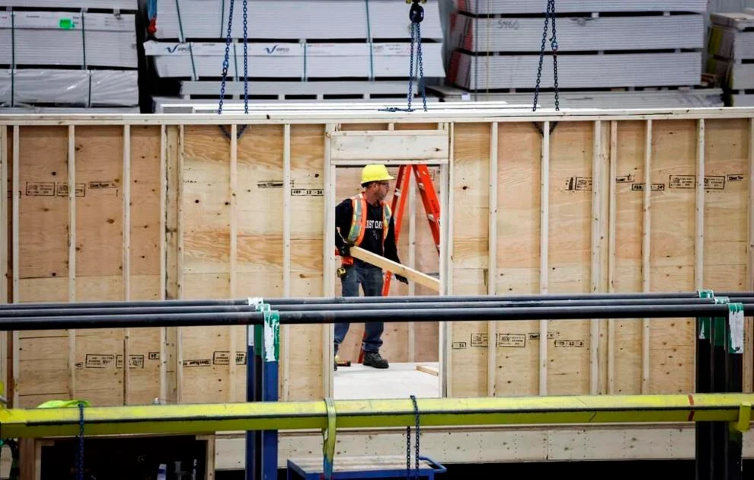
As the national housing agency continues to forecast housing start levels that likely won't be enough to meet Canada's growing demand, experts say solving the longstanding labor shortage in the construction sector will be one key to solving the issue. An employee works on a modular home component in Calgary, Friday, April 5, 2024. THE CANADIAN PRESS
Experts emphasize that addressing the prolonged shortage of construction workers is crucial for increasing housing supply in Canada. The Canada Mortgage and Housing Corp. (CMHC) identifies the construction labor shortage, along with larger project sizes and rising costs, as a factor contributing to extended construction times in a recent housing supply report. This challenge has been exacerbated by the pandemic, which led to some construction workers changing careers or retiring prematurely, resulting in a reduction in the overall labor force.
Jordan Thomson, senior manager of infrastructure advisory at KPMG in Canada, describes the situation as a long-anticipated issue that has now become more acute due to the combination of a heavy workload and a diminishing workforce. The industry is grappling with the task of replacing retiring workers while simultaneously expanding to meet the increasing demand for housing.
According to Kevin Lee, CEO of the Canadian Home Builders’ Association, approximately 22 percent of residential construction workers are expected to retire over the next decade. While the labor shortage has been somewhat mitigated by reduced demand from potential homebuyers due to high borrowing costs, a rebound in demand could exacerbate the strain on the sector.
A report by RBC assistant chief economist Robert Hogue, titled "The Great Rebuild," indicates that Canada may require over 500,000 additional construction workers on average to meet housing needs until 2030. The report suggests aggressively expanding the construction sector’s labor pool as a primary solution to address the housing shortage.
Hogue advocates for various measures to attract more people to the construction sector, including prioritizing construction skills among new immigrants, setting ambitious targets for skilled trade school enrollments, and encouraging older construction workers to remain in the labor force longer. Failure to address the labor shortage may impede efforts to solve affordability and housing crises.
The federal budget acknowledges the contribution of skilled labor shortages to barriers hindering new housing supply and affordability pressures. The government proposes initiatives to encourage more individuals to pursue careers in the skilled trades and to facilitate foreign credential recognition for construction workers. Additionally, the budget allocates funds for apprenticeship opportunities and a summer jobs program targeting sectors facing critical labor shortages, such as housing construction.
Mary Van Buren, president of the Canadian Construction Association, highlights the need to prioritize immigrants with skilled trade backgrounds to address the immediate need for workers and enhance Canada's competitiveness in attracting skilled trades workers globally.
Kevin Lee suggests transitioning to more factory-built homes as a medium-to-long-term solution to increase productivity in the construction sector. Despite an influx of immigrants, a survey by KPMG indicates that many organizations in real estate and construction still lack the skilled talent needed for growth.
Jordan Thomson emphasizes the urgency of implementing innovative approaches, such as prefabricated homes and digital tools, to improve productivity on construction sites. He stresses the importance of exploring alternative construction methods to accelerate housing construction and infrastructure projects.