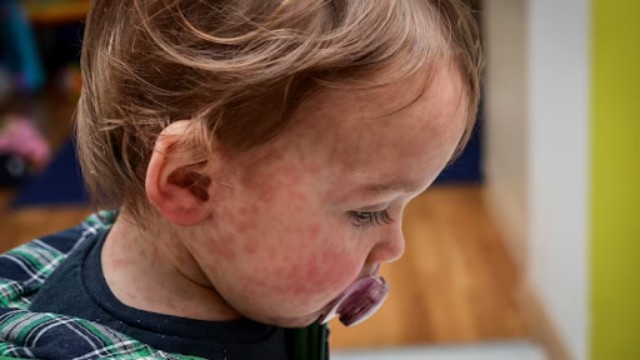
A child shows a measles rash. The recent increase in measles cases in Canada might explain why most people in a recent Angus Reid survey said childhood vaccinations should be required. (JGA/Shutterstock)
Measles cases are rising sharply in Canada, sparking concern among many families. A recent survey shows that nearly 70 percent of Canadians believe childhood vaccinations should be mandatory, reflecting growing support for immunization policies.
The poll, conducted by the Angus Reid Institute, gathered opinions from about 1,700 Canadian adults between May 20 and 23. It asked whether proof of vaccination should be required for children to attend daycare or school. The results showed a strong increase from last year, when only 55 percent supported mandatory vaccinations for kids.
Maxwell Smith, a bioethicist from Western University, noted that this shift reveals how public opinion on vaccine mandates is evolving. “Considering the recent COVID-19 debates about vaccine rules, this rising agreement is surprising and significant,” he said.
Currently, Canada faces its worst measles outbreak since 1998, when the disease was declared eliminated. Ontario has been hit the hardest, with nearly 2,000 confirmed cases so far in 2025. This surge seems to be influencing people's views on vaccines.
Smith explained that when a serious health risk threatens children, public attitudes can change quickly. “In a crisis like this, where children’s health is at stake, people often reach a turning point,” he added.
Some provinces already require children to show proof of vaccination for school enrollment. In Ontario and New Brunswick, parents can still apply for exemptions due to medical, religious, or personal beliefs. However, they must complete forms, watch educational videos, and agree to remove their children from school during outbreaks.
Despite the outbreak, Ontario’s Premier Doug Ford said he does not support forcing vaccinations. “You can’t just grab kids and force shots on them,” he told reporters, emphasizing parental choice.
The poll also asked Canadians how confident they are in their local governments’ ability to handle the measles outbreak. The answers were concerning: 27 percent of Ontarians had no confidence at all in their province’s response. In Alberta, where over 600 cases have been reported this year, distrust was even higher at 37 percent.
It’s important to note that the survey did not include responses from Canada’s three northern territories due to low participation. Also, since the poll was conducted online, it doesn’t have a margin of error but reflects a solid sample of the population.
This rising support for mandatory vaccinations and concerns about public health responses underline a growing urgency in Canada to address vaccine-preventable diseases seriously.