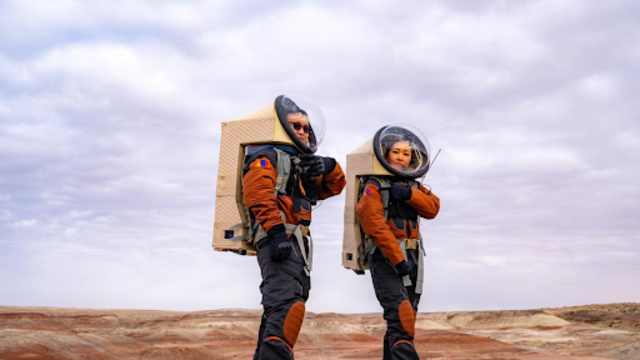
The MARS-V team is trying out new prototype spacesuits designed for their Mars simulation program. CNN
Imagine waking up in a tiny sleeping pod surrounded by frozen red sand. The air outside bites at -30°C, and the nearest town lies hundreds of kilometres away. You slip into your thermal gear, zip up your spacesuit, and prepare to face another day on “Mars.”
This is not a movie set. It’s part of Mongolia’s MARS-V Project, a month-long survival adventure designed to simulate life on the red planet. Located deep in the Gobi Desert, this extreme camp aims to train scientists — and thrill-seeking tourists — to handle the harsh conditions humans might one day face on Mars.
Why Mongolia’s Gobi Desert?
Few places on Earth resemble Mars as closely as Mongolia’s Gobi. The desert’s rocky red soil, dramatic temperature swings, and endless horizons make it the perfect stand-in for the Martian landscape. Temperatures here range from a scorching 45°C in summer to a bone-chilling -40°C in winter.
“This is about survival in complete isolation,” says Enkhtuvshin Doyodkhuu, CEO of MARS-V. “You have to think like you’re on another planet. If you don’t follow the rules, you could die.”
The camp’s location not only mimics Mars but also provides valuable research opportunities. Scientists can test equipment and rover prototypes in an environment almost identical to what astronauts might face on the red planet.
Training for the Impossible
Before stepping foot in the desert, participants must pass strict fitness and psychological tests. They also complete a three-month online course covering everything from oxygen systems to stress management. Once in Mongolia, trainees spend three more days in Ulaanbaatar for team exercises before giving up their phones and travelling ten hours across the desert to reach the isolated camp.
At the site, participants live in modular “Mars habitats” — interconnected pods that include living quarters, a lab, and even a small greenhouse. Each day follows a structured astronaut-style routine with meditation, exercise, and team meetings.
“Meditation is essential,” says Doyodkhuu. “We don’t know how people will react to that kind of isolation. You miss Earth after a while.”
Tasks at the camp include collecting soil samples, using rovers, and conducting mock research missions. Communication with “Earth” — the mission control team — runs on a time delay to simulate real interplanetary lag.
Realism Meets Safety
The environment feels unforgiving but remains closely monitored. “It’s controlled,” Doyodkhuu explains. “If anything becomes truly dangerous, we stop the simulation.”
Meals include freeze-dried Mongolian dishes like dumplings and mutton stew, combining astronaut food style with local flavour. The camp’s dome-shaped living quarters even take inspiration from traditional Mongolian gers — round tents used for centuries by nomads in remote regions.
“Mongolians have always survived with limited resources,” Doyodkhuu adds. “We’re just taking that experience to another planet.”
Adventure for the Future
While NASA and other agencies have run similar Mars simulations, MARS-V stands out for combining science with tourism. The camp aims to open to the public by 2029, with prices around $6,000 for a month-long stay, including training.
For many, it’s a chance to live a dream once limited to astronauts — without the $28 million price tag of space flights.
“You get time to think,” says Doyodkhuu. “Spending a month in this otherworldly place changes your view of life.”
For adventurous travellers ready to face freezing winds and isolation, Mongolia’s MARS-V camp promises the closest experience to space without leaving Earth.