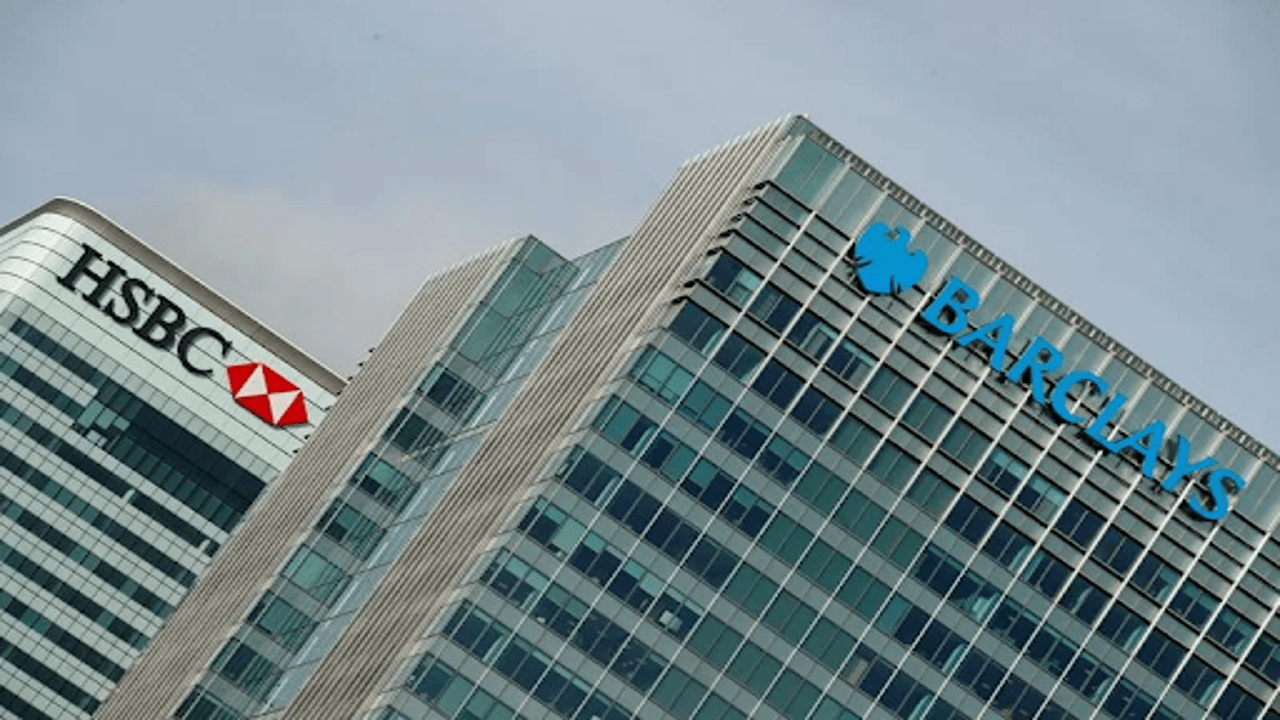
Barclays and HSBC buildings in London, UK, as seen in a file photo.
British banks HSBC, Barclays, and Standard Chartered are increasingly targeting U.S. commercial banking as demand for international financial expertise grows among American corporations. This new focus aligns with U.S. economic growth and rising interest rates, which have helped expand the commercial banking sector's revenues. According to data from consulting firm BCG, U.S. commercial banking revenues surged from $310 billion in 2019 to $429 billion in 2023. Despite currently holding a small market share, European banks see strong growth potential in this lucrative market.
HSBC, with a major presence in Asia, views its U.S. strategy as a way to leverage its international trade expertise. Stuart Tait, head of HSBC UK's commercial banking division, noted that trade between the U.K. and the U.S. has been particularly active. In the year leading up to June 30, payments from HSBC’s U.K. business clients to U.S. counterparts grew by 15%, and transactions in the opposite direction also saw a 5% increase. Notably, HSBC recorded a 71% rise in U.S. acquisitions of U.K. businesses and a 45% increase in U.K. companies entering the U.S. market within the first six months of 2024.
British banks, especially HSBC, are capitalizing on trade routes, or "corridors," that link clients across major markets. HSBC’s recent strategic expansion in the U.S. is partly a pivot from past challenges in other European markets, where it has struggled to attract domestic corporate clients. Meanwhile, HSBC and Standard Chartered have faced recent difficulties in Asia, especially in China, due to the ongoing real estate crisis, prompting them to seek opportunities in the more stable U.S. market.
Barclays has also experienced a significant rise in U.S.-generated revenue, moving from 25% of total revenue in 2022 to 31% in 2023, largely due to robust growth in its trading and credit card businesses. Barclays reported an increase in U.S. consumer banking profitability, achieving an 8.4% return on tangible equity through September 2024, compared to 5.7% the previous year. This growth has prompted Barclays to double its U.S. dollar deposits at its New York branch, and the bank continues to add experts to capture more of the U.S. market.
Standard Chartered, which has traditionally focused on emerging markets, is leveraging its relationships in Asia, Africa, and the Middle East to assist U.S. companies expanding in those regions. Chief Financial Officer Diego De Giorgi revealed that the bank aims to grow its investment banking revenue from U.S. clients to reach 60% by next year.
As U.S. revenue becomes increasingly critical for these British banks, the upcoming U.S. election has sparked questions about future policy impacts. However, executives remain cautious, stating that the election results alone will not dictate policy. Barclays CEO C.S. Venkatakrishnan emphasized that policy shifts will also depend on key officials’ appointments and their Senate confirmations, likely taking until early 2025 to fully unfold.
As HSBC, Barclays, and Standard Chartered ramp up their U.S. operations, the stage is set for intensified competition among major players. Their commitment to seizing U.S. commercial banking opportunities reflects a strategic shift toward the stability and profitability of this growing sector.