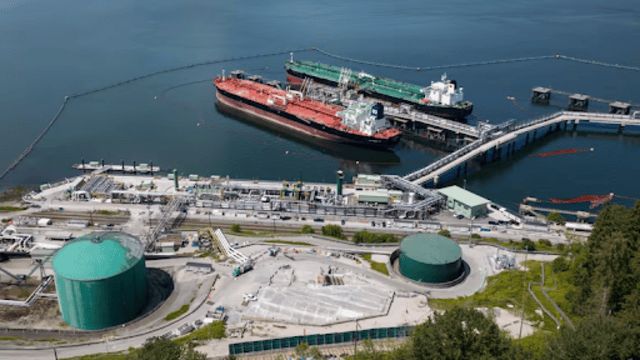
A photo taken in June 2024 shows two oil tankers docked at the Trans Mountain Westridge Marine Terminal in Burnaby, B.C. Recent shipping records reveal that China has become the leading buyer of Canadian oil transported through the newly expanded Trans Mountain Pipeline.
In a major shift in global oil trade, China has become the biggest buyer of Canadian crude shipped through the newly expanded Trans Mountain Pipeline. This change, revealed through ship tracking data, shows how international politics and energy strategy are redrawing global oil maps.
The $34-billion expansion of the Trans Mountain Pipeline, which began operating on May 1, 2024, tripled its capacity to 890,000 barrels per day. It now connects Alberta’s oil reserves—trapped inland—with ports on Canada’s Pacific coast. That has opened the door for Canadian oil to reach overseas markets, especially in Asia.
Since the full operation of the pipeline began last June, Canada has shipped an average of 207,000 barrels of oil per day to China, compared to just 7,000 barrels daily in the decade prior. That’s nearly 30 times more than earlier volumes. By contrast, the U.S. imported around 173,000 barrels per day through the same route over the same period.
This outcome surprised many experts who had expected the U.S.—due to its proximity—to dominate purchases. However, recent U.S. trade policies and sanctions have pushed countries like China to seek other oil sources. China, in particular, appears eager to reduce its reliance on oil from countries facing U.S. sanctions, like Venezuela and Russia.
China’s growing interest in Canadian oil also comes at a time when relations between the U.S. and Canada have faced challenges. Brief tariffs and political tensions during Donald Trump's presidency made Canada rethink its export strategy. Though oil isn’t currently hit by U.S. tariffs, the Canadian government has been exploring alternative markets to reduce overdependence on its southern neighbor.
Canada, the world’s fourth-largest oil producer, still sends most of its crude to the U.S., but exports to non-U.S. buyers rose by nearly 60% in 2024, setting a new annual record of 183,000 barrels per day, according to Statistics Canada. Other Asian buyers like South Korea, Japan, India, Taiwan, and Brunei have also ramped up purchases.
Despite the success of the Trans Mountain expansion, filling the pipeline to capacity has proven tricky. In 2024, the line ran at about 77% of its full capacity, falling short of its forecasted 83%. High transportation fees—introduced to cover construction cost overruns—played a role. The operator, Trans Mountain Corp, hopes to push usage up to 84% in 2025 and 92% by 2027.
Looking ahead, the company is exploring ways to further expand the pipeline’s capacity by 200,000 to 300,000 barrels per day. Given China’s growing appetite for dependable oil sources, much of this extra capacity could head straight to Asia.
Experts like Skip York from Turner, Mason & Company believe future shipments will largely continue flowing westward across the Pacific, marking a long-term shift in Canada’s oil export landscape.