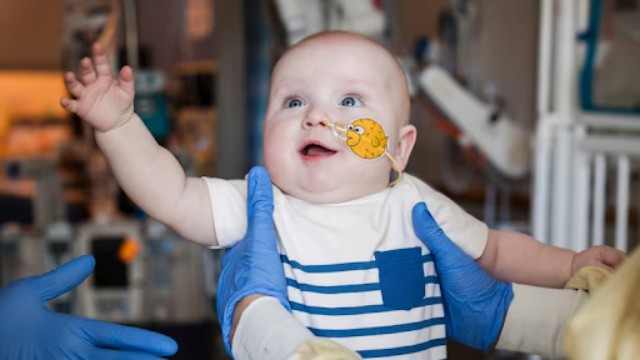
KJ Muldoon is pictured in April 2025 at the hospital after receiving a second dose of an experimental gene therapy. (Chloe Dawson/Children's Hospital of Philadelphia/The Associated Press)
A baby boy from Pennsylvania is now thriving after doctors treated him with a groundbreaking, tailor-made gene therapy — a first-of-its-kind approach to fixing a rare and deadly genetic disorder.
Born with a condition so rare it affects only about one in a million newborns, baby KJ Muldoon had a bleak outlook. He was diagnosed shortly after birth with CPS1 deficiency, a genetic disorder that prevents the body from removing ammonia from the blood. Without that process, toxic levels can build up quickly, leading to life-threatening complications. Many infants with this disorder don’t survive past infancy, and liver transplants are often the only hope.
KJ’s parents, Kyle and Nicole Muldoon, were devastated but determined. Faced with the risks of invasive surgery or trying something that had never been done before, they chose to take a chance on science. Their choice led them to a team of doctors at Children’s Hospital of Philadelphia (CHOP) and Penn Medicine who offered to develop a personalized gene therapy just for KJ.
Over six months, researchers built a therapy using a newer form of CRISPR, a gene editing tool. Rather than snipping the DNA, this version — called base editing — simply swaps out a single faulty letter in KJ’s DNA code for the correct one, lowering the risk of unwanted changes elsewhere in the genome.
In February, KJ received the first dose of the therapy via an IV drip. The medicine was wrapped in microscopic fatty droplets designed to deliver it directly to his liver cells. While the medical team buzzed with anticipation, KJ calmly slept through the entire session.
After additional doses in March and April, the results have been nothing short of remarkable. KJ has shown improvement in eating, his medication needs have dropped, and he’s recovering more easily from common illnesses. At just over nine months old, he’s hitting developmental milestones — from small waves to rolling over — that once seemed unreachable.
Still, doctors urge caution. It’s too early to say what the long-term effects will be. Dr. Rebecca Ahrens-Nicklas, who’s been closely involved in KJ’s care, said it will take years of monitoring to understand the full impact. But every day, she said, brings more encouraging signs.
Beyond saving one child, this case may change how doctors treat other rare diseases. Traditionally, gene therapies are developed for more common conditions because of cost and potential return on investment. But Dr. Kiran Musunuru, a co-author of the study, pointed out that KJ’s custom therapy didn’t cost much more than a liver transplant — around $800,000. As the process becomes faster and more efficient, he believes these therapies could become more affordable.
Experts agree that this case sets the foundation for more custom treatments, potentially transforming the future for patients with rare disorders. As Dr. Carlos Moraes from the University of Miami put it, once such breakthroughs are made, progress in the field often follows quickly.