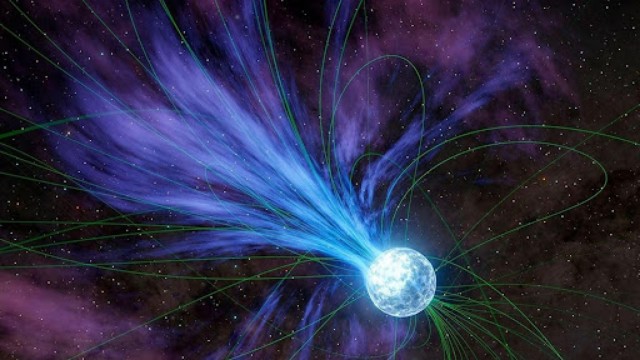
This illustration shows a magnetar pushing matter out into space. The green lines represent its magnetic field, which controls how the charged particles move around it. (NASA/JPL-Caltech via CNN Newsource)
A recent discovery may have brought scientists one step closer to solving a long-standing mystery: where does gold come from in the universe?
For decades, astronomers have known that elements like hydrogen and helium were formed shortly after the Big Bang, about 13.8 billion years ago. Heavier elements like iron appeared later, born from massive stars that exploded. But gold, heavier and rarer, has remained harder to explain.
A new study, led by Columbia University physics Ph.D. student Anirudh Patel, offers a fresh theory. Researchers now think that magnetars—rare, hyper-magnetized remnants of exploded stars—could be part of the answer.
Until now, the most accepted explanation for gold’s origin pointed to collisions between neutron stars. One such event observed in 2017 produced gravitational waves, gamma-ray bursts, and a heavy-element wind including gold and platinum. These dramatic explosions, called kilonovas, were likened to cosmic gold factories. However, these collisions seem to have occurred relatively recently in the universe's timeline.
But a new look at decades-old data from space missions has added an intriguing twist. Scientists examined readings from the European Space Agency’s retired INTEGRAL satellite and NASA’s RHESSI and Wind missions. In these old files, they found a 2004 gamma-ray flare from a magnetar that closely matched predictions made in 2024 about gold-forming explosions.
Magnetars are incredibly dense neutron stars with magnetic fields trillions of times stronger than Earth's. They occasionally release giant flares of radiation, sometimes caused by "starquakes"—intense surface crackings similar to earthquakes. These violent episodes can blast out material from the star’s crust.
Patel and his team suspect these explosive flares might be powerful enough to form heavy elements like gold. According to recent models, such eruptions may create the right conditions for heavier metals to be born.
Still, not everyone is convinced. Dr. Eleonora Troja, an astrophysicist from the University of Rome who studied the 2017 neutron star collision, believes this theory is intriguing but not definitive. Magnetars are chaotic objects, she said, and their conditions might more easily form lighter metals like silver or zirconium.
Even so, Patel’s team thinks magnetar flares could account for up to 10% of the heavy elements in our Milky Way galaxy. Upcoming space missions, like NASA’s Compton Spectrometer and Imager (COSI), set to launch in 2027, might offer clearer answers. This telescope will specialize in observing magnetar flares and tracking the elements created in their violent aftermath.
For now, the possibility that some of the gold in our jewelry—or even our smartphones—originated from these starquakes billions of years ago adds a stunning new layer to our cosmic history.