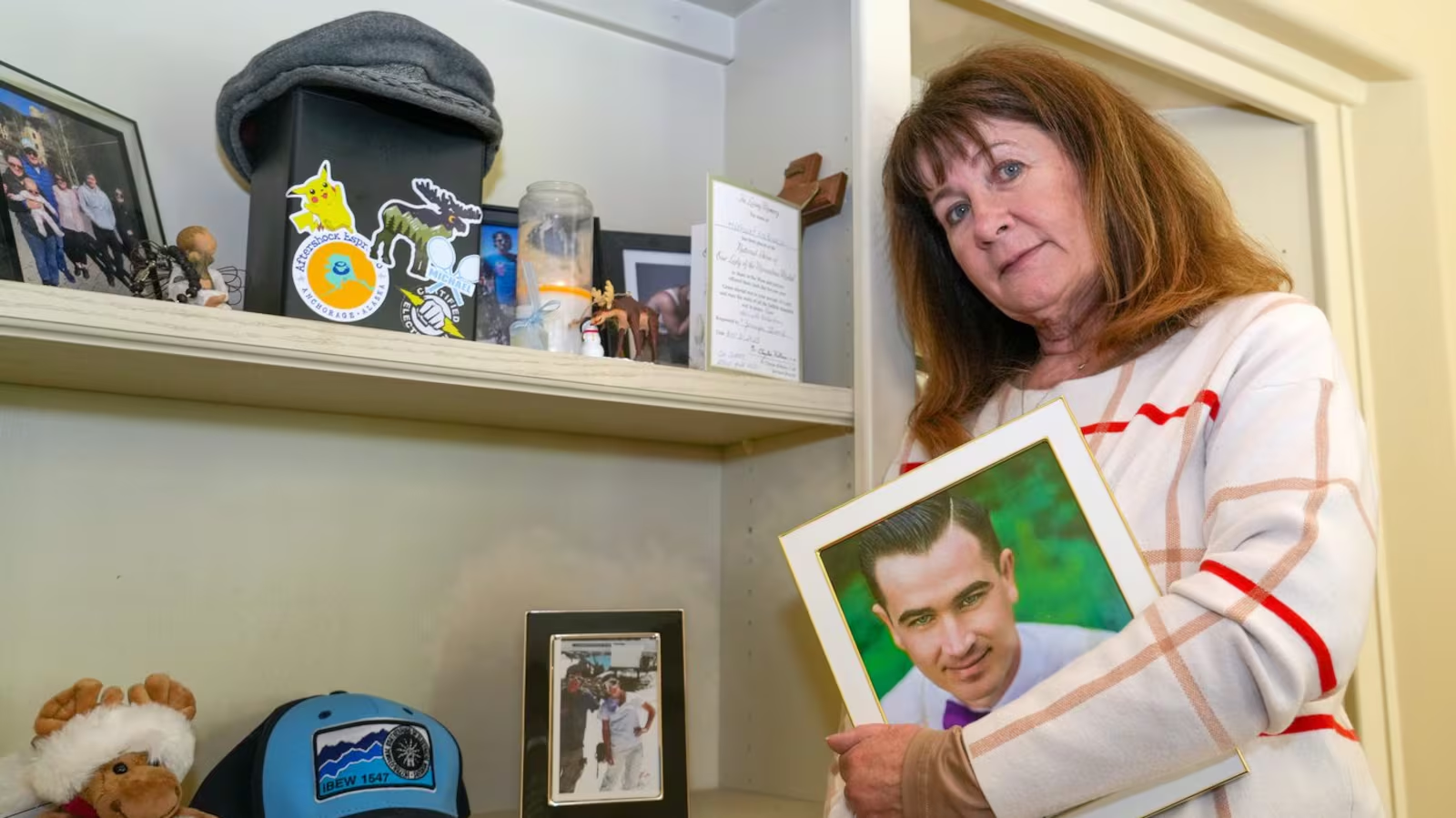
Kelley Nalewaja stands by a memorial for her son, Michael Nalewaja, seen in the photo, who died after unknowingly taking a lethal cocktail of fentanyl and carfentanil in November 2025, at her home in El Dorado Hills, Calif., Thursday, April 16, 2026. (AP Photo)
A quiet life can unravel in seconds. For 36-year-old Michael Nalewaja, it did just days before Thanksgiving 2025. Living in Alaska and working as an electrician, he had long moved past the struggles of addiction that marked his youth. But a single, unknowingly fatal dose of a drug mixture changed everything.
His family believes he and a friend consumed what they thought was cocaine. Instead, it contained fentanyl laced with carfentanil, a substance so potent that survival was nearly impossible. “Even if help had arrived in time, he wouldn’t have made it,” his mother said, describing the moment she learned of his death.
A Drug Far Deadlier Than Fentanyl
Carfentanil is not just another opioid. Originally developed to sedate large animals like elephants, it is estimated to be 10,000 times stronger than morphine and about 100 times more potent than fentanyl. Even a tiny amount, smaller than a grain of salt, can be lethal.
Authorities across the United States are now seeing a troubling comeback of this substance. Its reappearance is especially alarming because it is being mixed into street drugs without users’ knowledge, dramatically increasing the risk of sudden death.
Why Is Carfentanil Back?
The resurgence appears linked to recent international crackdowns on fentanyl production. Tighter controls on precursor chemicals, particularly from China, have disrupted supply chains. In response, drug traffickers, especially in Mexico, are reportedly turning to carfentanil to maintain potency while using less fentanyl.
U.S. Drug Enforcement Administration (DEA) labs detected carfentanil in drug seizures 1,400 times in 2025, a massive jump from just 54 cases in 2022. This sharp rise suggests not just increased availability, but also experimentation within the illegal drug market.
A Dangerous Paradox
At first glance, there is a silver lining. Drug overdose deaths in the U.S. have been declining for over two years, and fentanyl seizures have dropped significantly. In 2025, authorities intercepted around 12,000 pounds of fentanyl, less than half the amount seized in 2023.
Experts attribute these improvements to wider access to naloxone, an overdose-reversal drug, and better addiction treatment services. However, carfentanil threatens to undo this progress. In many cases, even multiple doses of naloxone may not be enough to reverse its effects.
A Substance With a Dark History
Carfentanil’s dangers are not new. It has been studied as a potential chemical weapon and was reportedly used during a hostage crisis in Russia in 2002. Its legal production is tightly controlled, with only small quantities permitted for veterinary use.
Despite this, illegal networks continue to find ways to manufacture or source it. Some traffickers are believed to be producing it in makeshift labs, while others may still be obtaining it through illicit online channels.

Kelley Nalewaja, right, looks over photos of her son, Michael Nalewaja, who died after unknowingly taking a lethal cocktail of fentanyl and carfentanil in November 2025, with her daughter, Caroline Bendel, at her home in El Dorado Hills, Calif., Thursday, April 16, 2026. (AP Photo)
Rising Deaths and Growing Concern
The numbers are already climbing. In 2024, deaths involving carfentanil nearly tripled compared to the previous year, reaching over 400 cases across most U.S. states. Recent seizures, including hundreds of thousands of counterfeit pills containing the drug, highlight how widespread the issue is becoming.
What makes the situation even more complex is demand. Some individuals with high tolerance to fentanyl are reportedly seeking stronger substances like carfentanil for a more intense effect. For traffickers, the appeal is simple economics. Small quantities yield massive profits.
Grief, Anger, and a Call for Change
For families like Nalewaja’s, the crisis is deeply personal. Instead of a traditional funeral, his mother organized a community meeting to raise awareness and push for stronger laws. She describes carfentanil not as a drug, but as something far more sinister.
In her words, it is not an overdose but a weapon.