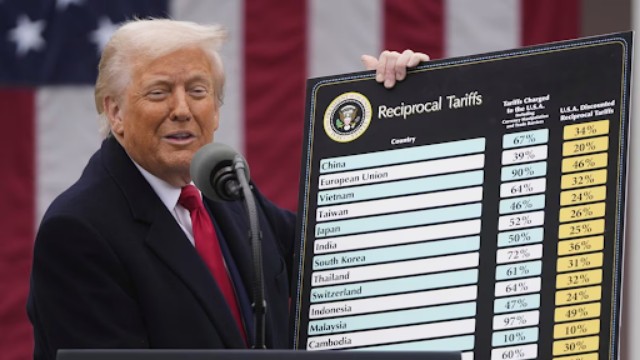
U.S. President Donald Trump addressed the nation from the White House Rose Garden on Wednesday, April 2, 2025, where he introduced a new set of tariffs during a formal event in Washington. (AP Photo/Mark Schiefelbein)
Former U.S. President Donald Trump’s aggressive trade policies are hitting a legal roadblock, but he’s already eyeing backup plans to keep his tariff strategy alive.
A federal appeals court is currently weighing whether to temporarily block tariffs Trump had placed using a rarely-used law—the International Emergency Economic Powers Act (IEEPA). This law, originally meant for national security crises, has never before been used for implementing trade tariffs.
Last month, the U.S. Court of International Trade declared those duties unlawful, ruling that Trump had overstepped presidential powers by using IEEPA to slap tariffs broadly. Trump’s response? He’s not backing down. The decision has been appealed, and the White House has signalled it’s prepared to fight the case all the way to the Supreme Court.
White House Economic Council Director Kevin Hassett remains hopeful that the courts will ultimately back Trump. But if not, he made it clear the administration has “other alternatives” to keep pushing its “fair trade” vision.
So, what are those alternatives?
One possible route is Section 338 of the Tariff Act of 1930. This provision allows a president to impose up to 50% tariffs if another country is treating U.S. goods unfairly compared to those of other countries. However, this law has never been used before, and legal experts believe proving such discrimination could be tough.
Another path is Section 301 of the Trade Act of 1974, which Trump used during his first term to target Chinese and European goods. This law allows for tariffs if a country's trade practices are found to be unfair. But there's a catch—it requires a detailed investigation for each country and a public feedback period, slowing down any swift action.
For faster results, Trump might turn to Section 122 of the same 1974 act, which permits temporary tariffs of up to 15% to correct major U.S. balance-of-payment issues. Yet this option has never been used either and comes with a 150-day limit unless Congress agrees to extend it. That time cap may make it harder for Trump to pressure countries into new trade deals.
Trade expert Greta Peisch, former general counsel at the U.S. Trade Representative’s office, pointed out that while these legal options exist, none of them easily replace the broad power Trump aimed to wield with IEEPA.
She notes that all of these tools demand legal groundwork, political negotiation, or both. “Nothing is a great fit without a lot of work,” Peisch said, hinting at the uphill legal and political battle Trump could face if he wants to revive or expand his tariff campaign.
As legal challenges mount, Trump is testing how far presidential authority can stretch in controlling international trade. What’s clear: his ambitions are big, but the legal landscape may not let him go as far—or as fast—as he hopes.