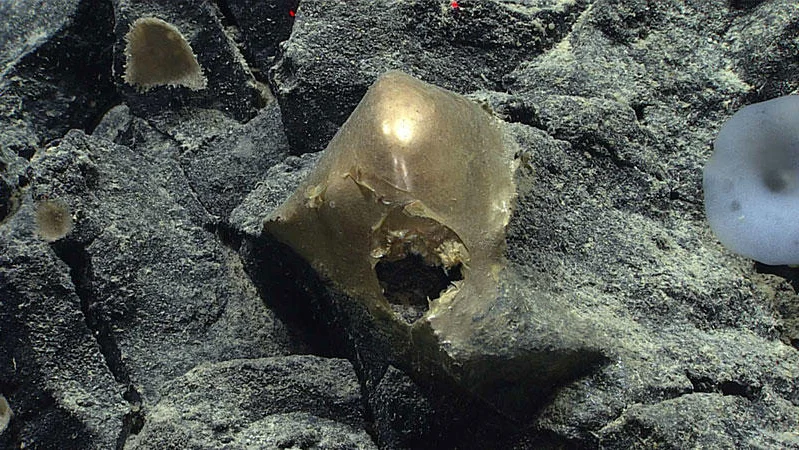
Researchers from National Oceanic and Atmospheric Administration spotted a mysterious golden, orb-shaped object while using a remote-operated deep-sea vehicle off the coast of Alaska on August 30. CBS News
Scientists have finally explained the origin of a strange “golden orb” discovered deep in the ocean off Alaska in 2023. Researchers made the unusual find thousands of feet below the surface while exploring the Gulf of Alaska using a remote-operated underwater vehicle.
The device spotted what officials described as a “strange, golden, mound-shaped object with a hole in it, stuck to a rock.” The team collected the object and sent it for further study.
A puzzling object draws attention
At first, experts believed they would quickly identify the object through routine analysis. However, the case proved more challenging than expected.
Allen Collins, a zoologist involved in the research, explained that the mystery required help from specialists in several fields. Scientists examined its structure, studied its genetic makeup, and used advanced tools to understand its nature.
“This turned into a special case that required focused efforts and expertise of several different individuals. This was a complex mystery that required morphological, genetic, deep-sea and bioinformatics expertise to solve,” Collins said.
Clues from structure and cells
Researchers began by studying the orb’s physical features. They discovered that it was not a typical animal. Instead, it consisted of fibrous material covered with special stinging cells.
These cells, known as spirocysts, help capture prey. Scientists usually find them in marine creatures like sea anemones and corals. Their presence gave researchers an important clue.
Comparing past findings
The team then compared the orb to a similar specimen collected in 2021. They noticed strong similarities between the two.
Initial DNA tests did not provide clear answers. However, more detailed genetic analysis revealed that both samples closely matched a known marine species called Relicanthus daphneae.
Further study showed that the golden orb once formed part of the base of a large sea anemone.
What happened to the rest?
Researchers believe the orb usually stays hidden beneath the anemone’s body. In this case, it appears the top part of the organism either moved away or died, leaving the base behind.
Scientists still do not know exactly what caused this separation.
The full anemone can grow quite large, with a pink, tube-shaped body that may reach up to three feet across. Its tentacles can stretch as long as six feet. The stinging cells it carries rank among the largest known in similar marine life.
Ongoing deep-sea exploration
Experts say discoveries like this show how much remains unknown about the deep ocean. New technology, including advanced DNA analysis, now allows scientists to solve mysteries that once seemed impossible.
William Mowitt, a senior official involved in ocean exploration, highlighted the importance of continued research.
"So often in deep ocean exploration, we find these captivating mysteries, like the 'golden orb,'" he said. "With advanced techniques like DNA sequencing, we are able to solve more and more of them. This is why we keep exploring—to unlock the secrets of the deep and better understand how the ocean and its resources can drive economic growth, strengthen our national security, and sustain our planet."