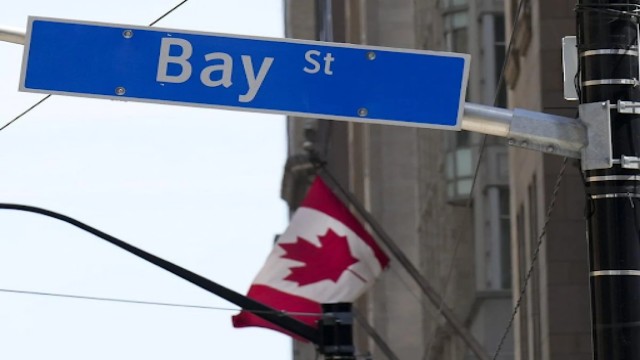
A view of Toronto's Bay Street Financial District with the Canadian flag visible, captured on Friday, August 5, 2022. (Photo credit: Nathan Denette, The Canadian Press)
Despite gains in energy, Canadian stocks dip amid global unease
Canada’s main stock index wrapped up Thursday with a modest drop, pulled down by investor nerves around U.S. interest rates and escalating tensions in the Middle East, despite a strong performance from energy stocks.
The S&P/TSX composite index fell by 53.85 points, ending the day at 26,506.00. U.S. markets were shut in observance of Juneteenth, offering fewer signals for Canadian investors to follow.
Fed Holds Steady, Eyes Rate Cuts
The U.S. Federal Reserve chose not to change its key interest rate in its latest decision on Wednesday. While this move wasn’t unexpected, the Fed’s messaging stirred fresh speculation. Officials still anticipate two rate cuts by the end of the year, keeping markets on edge.
“They’re keeping their options open,” said Tamsin Wilding, principal and portfolio manager at Leith Wheeler Investment Counsel Ltd. She noted that while the Fed downgraded its U.S. economic growth forecast, it also raised its inflation expectations.
This dual message has created some confusion and uncertainty in global markets.
Iran-Israel Conflict Fuels Caution
Adding to the unease was the continued conflict between Iran and Israel, which has captured headlines and rattled nerves. The two nations exchanged fresh attacks, prompting further concern about regional stability.
Former U.S. President Donald Trump said he would decide within two weeks whether to launch a direct strike on Iran. However, he also left the door open for diplomacy, particularly regarding Tehran’s nuclear ambitions.
“There’s definitely some hesitation in the market,” Wilding added. “Headlines like these make investors a bit jumpy.”
Empire Co. Posts Strong Gains
On a more upbeat note, Empire Co. Ltd. — the parent company of Sobeys and Safeway — saw its shares rise by 5.3% after posting strong earnings.
The company earned $173 million, or 74 cents per diluted share, for the quarter ending May 3. That’s a notable increase from $149 million, or 61 cents per diluted share, in the same quarter last year.
CEO Michael Medline pointed out that their internal inflation tracking came in far below what Statistics Canada reported in its consumer price index. This suggests the company managed costs more effectively than many competitors.
BMO Dips After Major Acquisition
Shares of Bank of Montreal (BMO), however, dropped by nearly 1% following news of a major acquisition. BMO announced it will purchase Burgundy Asset Management, a Toronto-based firm, for $625 million. While strategic, the move sparked mixed reactions from investors.
Canadian Dollar Takes a Hit
The Canadian dollar also slipped, trading at 72.87 cents U.S., down from 73.14 cents U.S. on Wednesday. The weaker loonie reflects broader caution in global currency markets amid economic and political uncertainty.