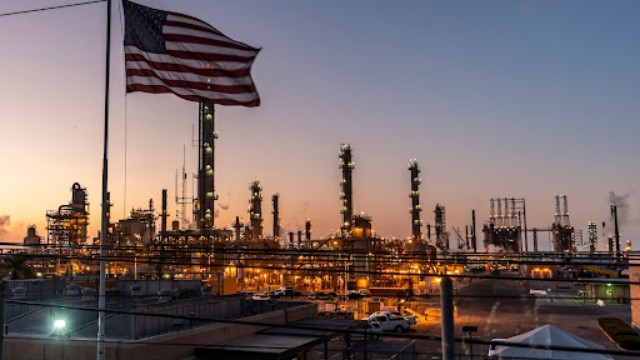
A flag is seen flying above Marathon Oil’s refinery in Carson, California (Photo: Damian Dovarganes/AP)
The U.S. economy may be heading for fresh inflation troubles after recent military action. On Sunday, the United States launched strikes targeting three nuclear facilities in Iran. The move is expected to trigger a sharp rise in oil prices, leading to potential fuel cost hikes for everyday Americans.
Experts warn that oil prices could jump by $5 per barrel when global markets reopen, possibly pushing the U.S. crude oil price to around $80 per barrel. This would mark the first time since January that prices hit this level. In recent months, oil prices stayed between $60 and $75, helping bring gas prices under $3 per gallon in many states.
That relief, however, may be short-lived.
Andy Lipow of Lipow Oil Associates expects this spike to begin immediately: “We’re looking at $80 oil when markets open.” Still, economists like Joe Brusuelas of RSM caution that this rise may not last. “Just because oil prices shoot up doesn’t mean they’ll stay up,” he explained.
Will Iran Shut Down a Critical Oil Route?
The real danger lies in Iran’s possible reaction. If Iran chooses to block the Strait of Hormuz — a narrow but vital passage that carries about 20% of the world’s oil — the economic impact could grow dramatically. Iran’s Foreign Minister Abbas Araghchi stated that the country is reviewing “multiple options” in response to the U.S. strikes.
One top advisor to Iran’s supreme leader has already urged shutting down the strait. That decision, if carried out, would likely invite even more U.S. military action and disrupt oil exports across the region.
Bob McNally, an energy expert and former White House adviser, believes Iran may see an oil crisis as a way to pressure Washington. “They might think a spike in oil prices will scare President Trump into backing off,” McNally said.
China’s Role: Can It Calm the Storm?
U.S. Secretary of State Marco Rubio turned attention to China during a Fox News interview on Sunday. He asked the Chinese government to step in and prevent Iran from closing the Strait of Hormuz. Rubio pointed out that China is far more dependent on oil from the Persian Gulf than the U.S.
“China buys nearly one-third of all oil shipped through that area,” Rubio said. “It’s in their best interest to make sure those waters stay open.”
How Soon Will Americans Feel the Pinch?
Gasoline prices in the U.S. could rise within days. Patrick De Haan, fuel expert at GasBuddy, explained that station prices usually adjust within five days after a surge in oil markets. “If oil jumps today, we could see pump prices climb in just a few hours,” he said.
Lipow warned that if Iran blocks the Strait of Hormuz, oil prices could soar to $100 per barrel. That would mean a 75-cent increase per gallon for both gas and diesel — an extra burden for American households.
The Bigger Picture: Inflation Risks Rise
Beyond gas, inflation across the U.S. may grow in the weeks ahead. With rising fuel prices and ongoing U.S.-Iran tensions, economist Joe Brusuelas expects higher inflation over the next three months. Many experts believe the low inflation seen earlier this year may just be the calm before a storm.
In short, global tensions, shifting trade policies, and surging oil prices may combine to push inflation higher — hitting wallets across the U.S.