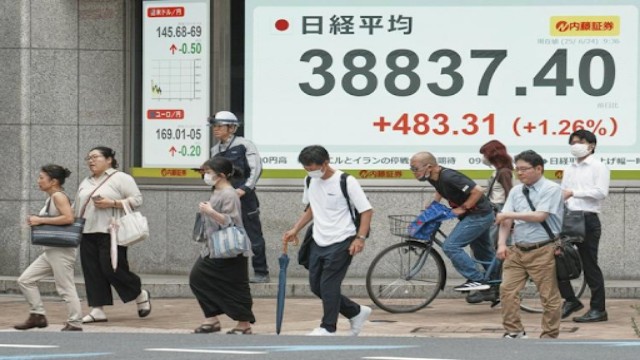
People are seen standing in front of an electronic stock board displaying Japan’s Nikkei index at a Tokyo securities office on Tuesday, June 24, 2025. (AP Photo/Eugene Hoshiko)
Asian markets climbed on Tuesday following U.S. President Donald Trump's announcement of a pending ceasefire between Israel and Iran. The optimism came despite lingering doubts, as violence continued and Israel hadn't confirmed any truce.
Trump took to Truth Social late Monday to declare that both sides had agreed to a “complete and total ceasefire,” to begin around midnight Tuesday (Eastern Time). This announcement followed Iran's limited missile strikes on a U.S. military base in Qatar. The attack was in response to recent American bombings of Iranian nuclear sites.
Despite Trump’s confident tone, confusion lingered. Israel hadn’t made any public confirmation of the ceasefire, and the timing of Iran’s missile launch muddied the situation further.
Still, markets responded with relief. Futures for major U.S. indices like the S&P 500 and the Dow Jones rose by 0.5%, signalling hope among investors.
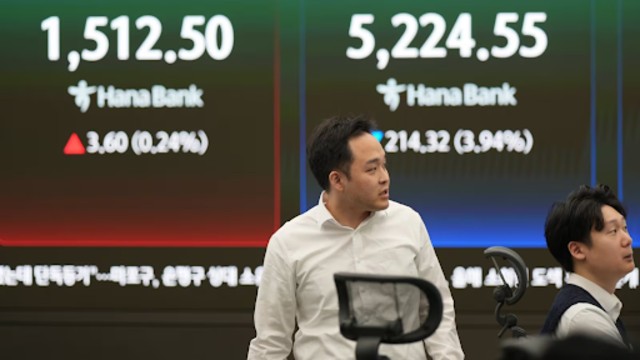
Asian stock markets showed even stronger gains. Japan’s Nikkei 225 rose 1% to close at 38,756.00, while Hong Kong’s Hang Seng surged 1.7% to 24,078.94. In mainland China, the Shanghai Composite climbed 0.9% to 3,411.92. South Korea’s Kospi made the biggest leap, gaining 2.3% to 3,082.90, and Australia’s S&P/ASX 200 added 0.9% to hit 8,551.40.
Oil prices, which had spiked initially after the U.S. bombing, continued to decline. Fears of Iran closing the Strait of Hormuz—a vital passage for global oil—had briefly pushed prices up 6% on Sunday night. But those gains evaporated quickly. By Tuesday, U.S. benchmark crude dropped another 2.7% to $66.67 a barrel, down from a high of $78. Brent Crude also slipped 2.5% to $69.68.
Despite the continued tensions, U.S. stocks closed Monday on a high note. The S&P 500 rose 1% to 6,025.17, the Dow climbed 0.9% to 42,581.78, and the Nasdaq gained 0.9% to 19,630.97. This came after a volatile week driven by uncertainty over the Middle East conflict.
Analysts noted that Iran’s actions appeared calibrated—they didn’t directly threaten oil flow, easing concerns about global energy supply disruption. Such fears had previously driven volatility, as higher oil prices could lead to costlier gasoline and rising inflation.
Meanwhile, back in the U.S., investors turned their focus to interest rates. Treasury yields eased after a Federal Reserve official signalled support for a rate cut—provided inflation stays in check. The 10-year Treasury yield dropped to 4.33% from 4.38%, while the 2-year yield slid to 3.84% from 3.90%.
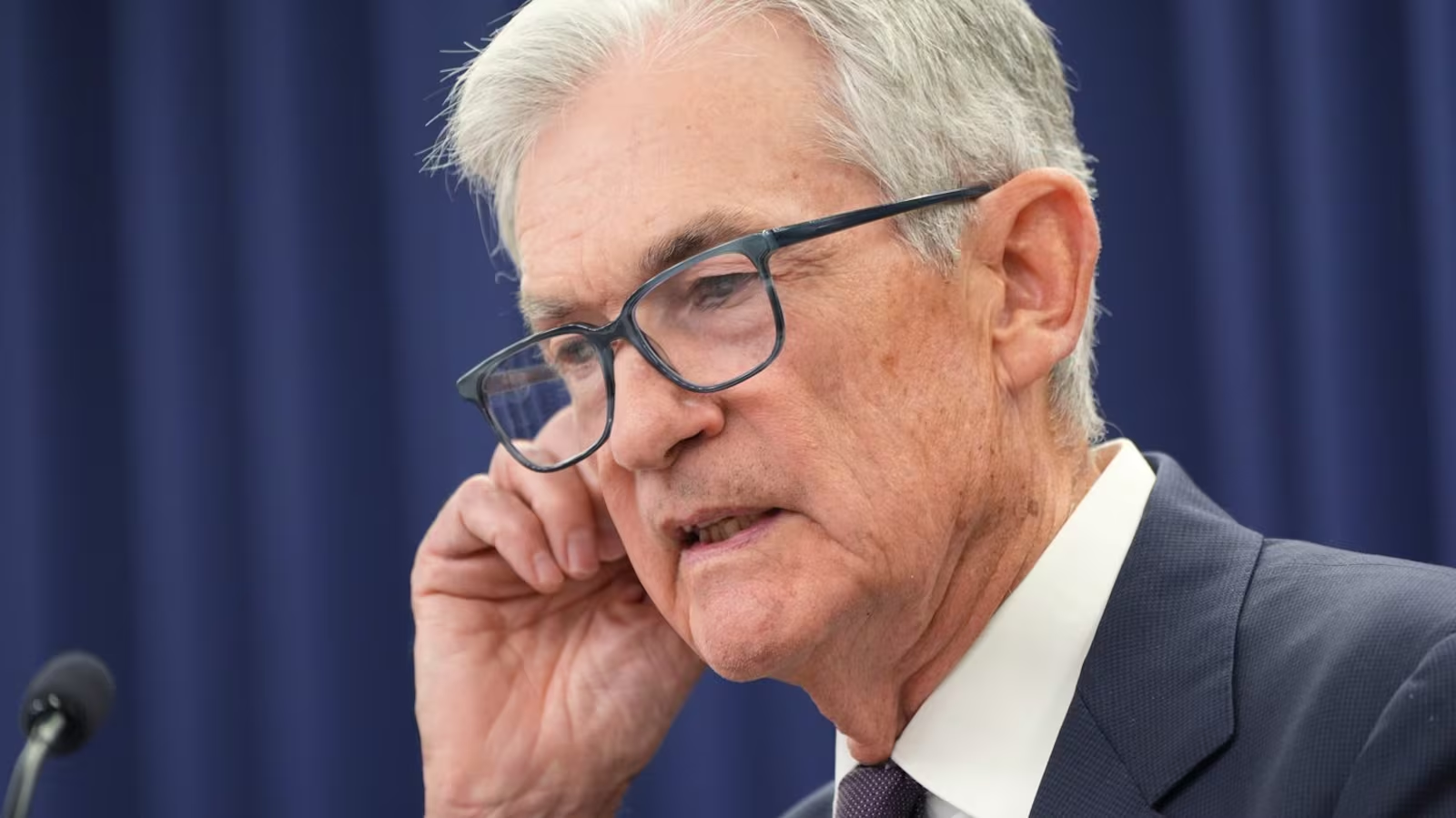
Federal Reserve Chair Jerome Powell was expected to address Congress later Tuesday. His comments could offer more clarity on the direction of interest rates, especially as rising oil costs could reignite inflation and affect the Fed’s cautious stance.
On Wall Street, Tesla stole the spotlight. The electric carmaker's stock soared 8.2% after launching a small fleet of self-driving taxis in Austin, Texas. The move reflects CEO Elon Musk’s vision and was key to driving the S&P 500 upward.
In contrast, Hims & Hers Health saw its shares nosedive 34.6% after pharmaceutical giant Novo Nordisk ended its partnership on selling Wegovy, a widely used weight-loss drug. Novo Nordisk shares also dropped 5.5%.
In currency markets, the dollar dipped slightly against the Japanese yen, falling to 145.34 from 145.16. The euro ticked up to $1.1604 from $1.1575.