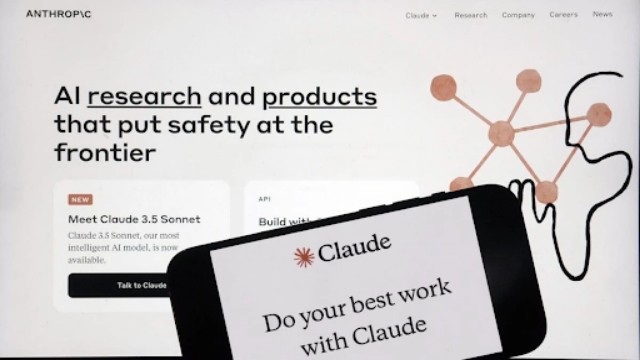
FILE - A phone screen and computer display show the Anthropic website and app, captured in New York (AP Photo/Richard Drew, File)
A major legal battle shaping the future of AI development took a key turn this week, as a U.S. judge ruled that Anthropic, an artificial intelligence company, did not violate copyright laws by using published books to train its AI system. However, the company will still need to face a trial over allegations that it downloaded those books illegally from online piracy sites.
In a ruling filed late Monday, U.S. District Judge William Alsup in San Francisco said that Anthropic’s use of millions of books to train its chatbot, Claude, fell under “fair use.” The judge explained that the AI system wasn’t just copying text—it was learning from the books and creating something entirely new.
“Anthropic’s models don’t simply mimic what they read. They learn, interpret, and generate original content,” Alsup wrote. “Like a writer inspired by what they’ve read, the AI doesn’t replicate but transforms.”
Still, the ruling wasn’t a full victory for Anthropic. While the court dismissed a major part of the copyright infringement claim brought by authors Andrea Bartz, Charles Graeber, and Kirk Wallace Johnson, it found that the way Anthropic acquired those books could still be illegal. The case is now set to go to trial in December to determine whether the company broke the law by downloading pirated books from so-called “shadow libraries.”
Alsup was clear in his criticism of Anthropic’s early actions, stating: “Anthropic had no right to use pirated books as the foundation for its training data.”
The authors’ lawsuit, filed in 2023, accused the AI company of “massive intellectual theft,” claiming it used their creative work without permission to build a product it now profits from. Books are a vital source of high-quality written content that developers use to train large language models, which are behind AI tools like chatbots and text generators.
Documents presented in court revealed that even Anthropic employees had internal concerns about the legality of using content from pirate websites. In response, the company eventually shifted course. They brought on Tom Turvey, a former Google executive involved in the company’s digitized book project, Google Books, to guide a more ethical approach. Anthropic then began legally purchasing books in bulk, removing their bindings, scanning each page, and feeding them into its system.
But according to the judge, that move came too late. “Buying a book later doesn’t erase the fact that it was first taken illegally,” Alsup noted. However, he also said this could influence the size of any financial penalties the company may face.
The outcome of this case could influence several ongoing lawsuits against other tech giants, including OpenAI and Meta, both of which have also faced similar accusations.
Anthropic, founded in 2021 by former OpenAI leaders, has promoted itself as a safer and more ethical AI developer. The company claims its mission is to build AI systems that serve society responsibly. However, the lawsuit argues that by relying on pirated materials, Anthropic has acted against its own values.
Following the ruling, Anthropic released a statement saying it was encouraged by the court’s recognition that its use of copyrighted works was transformative and aligned with the broader goals of copyright law—to promote innovation and learning. The company, however, did not comment on the piracy allegations.
The legal team representing the authors declined to speak on the ruling.