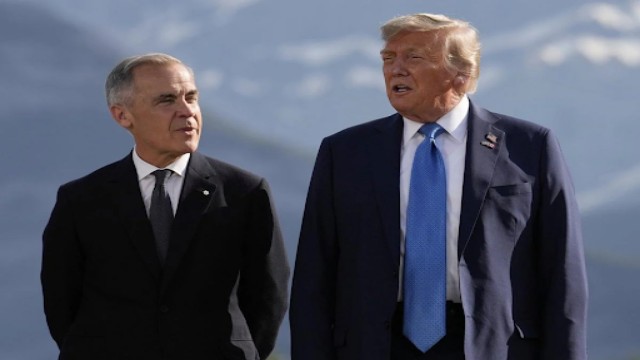
Canadian Prime Minister Mark Carney listens while U.S. President Donald Trump speaks during a group photo at the G7 Summit on Monday, June 16, 2025, in Kananaskis, Canada. (Photo: Mark Schiefelbein/AP)
Canada has decided to withdraw its digital services tax aimed at big tech companies, just before the first payment was due. This move comes after a tense exchange between Canadian Prime Minister Mark Carney and U.S. President Donald Trump, who had recently halted trade talks over the issue.
Finance Minister François-Philippe Champagne confirmed the decision in a statement released late Sunday. The timing of this announcement was crucial—just hours before tech giants like Google, Meta, and Amazon were set to pay billions under the new rule.
The breakthrough followed a phone call between Carney and Trump. The conversation helped reset the tone between the two nations after Trump had abruptly announced—via his social media platform Truth Social—that he was ending all trade negotiations with Canada. He called the tax a “blatant attack” on the U.S. and threatened steep tariffs unless Canada backed off.
Talks to Resume Ahead of G7 Deadline
Carney, in a written statement, emphasized that this decision will help revive discussions aimed at reaching an agreement by July 21, as planned during the G7 Summit earlier this month. He stressed that Canada’s trade talks will always prioritize the welfare of Canadian workers and businesses.
Champagne also reached out to U.S. Treasury Secretary Scott Bessent to reinforce Canada’s willingness to return to the negotiating table.
The original tax was designed to target all large digital firms offering online ads, e-commerce, or social media platforms—especially those profiting from user data. Though not written specifically against American firms, U.S. tech giants were the most heavily impacted.
Trump’s Pressure Changes Course
Trump’s threats and public criticisms clearly pressured Canada to reverse its decision. Less than two weeks ago, Carney and Trump had a seemingly friendly exchange at the G7, where they agreed to conclude trade talks within a month. But Trump's tone changed dramatically after that meeting, leading to fears of another wave of tariffs.
Back in early May, Carney had visited the White House post-election, and both leaders agreed to draft a new economic and security deal. But after Trump’s recent move to double tariffs on aluminum and steel, the mood soured. The threat of further penalties made Canada rethink its strategy.
Although the White House has yet to respond to Canada’s withdrawal of the tax, it’s clear the move has softened tensions—for now.
Billions at Stake
Originally introduced by the Trudeau government in 2019 and passed into law in 2024, the digital services tax would have collected roughly $7.2 billion over five years. The first payment, due Monday, was retroactive and estimated at $2 billion. Most of it would have come from American tech companies.
Daniel Béland, a political expert at McGill University, called the withdrawal a clear win for Trump and Big Tech. He noted that the move could make Carney appear weak under U.S. pressure.
“Trump forced Carney to act in Big Tech’s favour. Tech companies in the U.S. will be thrilled,” Béland said.