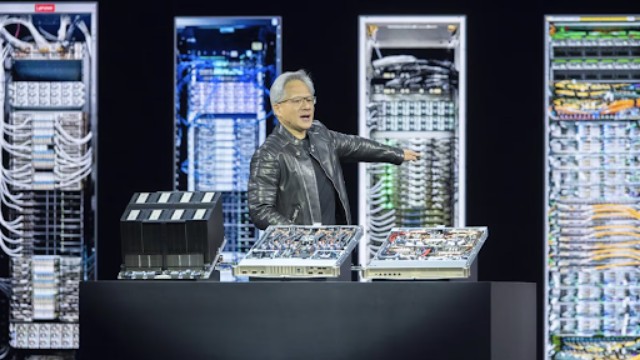
Nvidia CEO Jensen Huang delivers his keynote speech at the GTC event held in San Jose, California. (AP Photo/Nic Coury)
Despite strict U.S. trade restrictions, advanced AI chips made by Nvidia—valued at over $1 billion—have quietly made their way into China over the past three months, according to The Financial Times.
These chips, especially the powerful B200 processors, are currently restricted for sale in China by U.S. authorities. But in a growing underground market, they’ve become surprisingly accessible. The report revealed that Chinese tech suppliers and data centers managed to get hold of these processors, bypassing U.S. export rules by operating through unauthorized channels.
Citing sales documents, company records, and insights from industry insiders, FT outlined how the chips were distributed by Chinese companies based in provinces like Guangdong, Zhejiang, and Anhui. They weren’t just trading the B200S; even other restricted models like the H100 and H200 were in circulation.
Nvidia responded to the news by emphasizing that using smuggled chips is not practical. A spokesperson said that running data centers on unauthorized hardware could lead to serious technical issues and higher costs. Official support from Nvidia is only available to licensed buyers, making black-market installations riskier and less reliable.
So far, the U.S. Commerce Department, the White House, and Thai officials haven’t commented on the situation. Reuters, which reported on the FT investigation, noted that it could not independently confirm every detail, but the implications are serious.
According to the report, the chip sales gained traction in May, with Chinese distributors beginning to openly sell B200 processors to AI-focused data center companies. The transaction channels appear to stretch beyond China, with Southeast Asian nations also playing a role. Experts say these countries, including Thailand, have become key entry points for restricted chips.
As the U.S. and China compete over control of emerging technologies like artificial intelligence, companies such as Nvidia find themselves caught in the crossfire. They must navigate a tense geopolitical climate while trying to serve global markets.
Interestingly, Nvidia recently received clearance to resume sales of certain chips, including the H20, after a temporary ban was reversed by the U.S. administration. That decision came in June, but the previous months already saw substantial unauthorized activity.
Now, in response to these smuggling concerns, U.S. officials are considering new export controls that could come into effect as soon as September. Thailand is expected to be one of the countries affected by these upcoming restrictions.
This latest development adds to the growing tension in the tech world, where innovation, trade rules, and national security are increasingly intertwined.