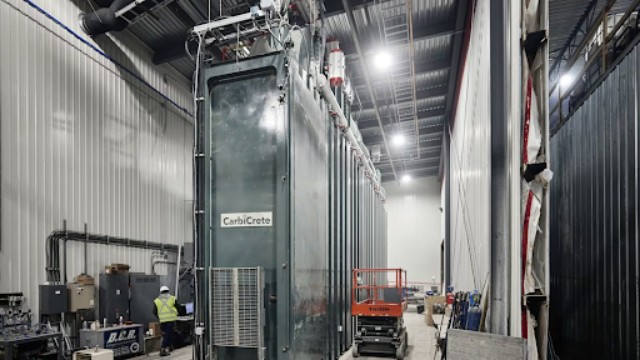
A curing chamber developed by CarbiCrete, where carbon dioxide is locked into concrete during the hardening process, is shown in this undated photo. (Credit: The Canadian Press/CarbiCrete, handout — Mandatory)
Carbon dioxide isn’t just a pollutant—it’s also becoming a resource. Canadian companies are now exploring innovative ways to turn this greenhouse gas into useful products that could bring in real revenue. From fuel and fertilizer to soap and construction materials, CO2 is showing promise beyond being stored underground.
Traditionally, Canada has focused on carbon capture and storage (CCS)—collecting CO2 from industrial sites and burying it deep beneath the earth. While this helps fight climate change, it doesn’t generate income. But now, a shift is underway. Some companies are asking: Why not turn carbon into something useful?
“Carbon utilization is still very new,” says Apoorv Sinha, CEO of Carbon Upcycling, a Calgary-based startup. His company mixes CO2 with industrial waste to create a cement alternative. This mixture can be used in sidewalks and building foundations. “Canada is leading the charge, especially in turning carbon into building materials,” he adds.
David Sanguinetti of Foresight Canada points out that while using CO2 in products could be profitable, it’s still early days. “The technology works, but the economics don’t always make sense—especially if there’s no carbon pricing to support it,” he explains.
In fact, Foresight was hired by the Canadian Gas Association to study carbon utilization. Their report found that storing carbon is currently more practical than using it—especially for large emitters. Still, areas like southwestern Ontario offer promise, thanks to a mix of heavy industries and innovation hubs—even though the region lacks Alberta’s underground storage.
CO2 usage generally falls into two main types:
- Direct Use: Injecting carbon into oilfields to push out more oil—a method used for years.
- Conversion: Changing CO2’s chemical makeup to create items like aviation fuel or fertilizer.
Some startups are getting creative on a smaller scale. Calgary’s CleanO2, for example, captures carbon from building heaters and uses it in soap and shampoo.
But it’s in construction where CO2 may find its biggest role. Carbon Upcycling is now working with Ash Grove’s cement plant in Mississauga, Ontario, to launch a commercial project that will start production next spring.
Montreal-based CarbiCrete is also pushing boundaries. It replaces traditional cement (which causes 8% of global emissions) with steel slag. The concrete is then cured with CO2, locking the gas away permanently. “The result is a strong, low-emission concrete,” says the company’s marketing head, Yuri Mytko. “And it works just like the cement version.”
CarbiCrete doesn’t sell blocks directly. Instead, it licenses the technology to manufacturers and helps them adapt their plants.
But experts caution against placing too much hope in this single solution. “Carbon utilization is helpful, but it’s just one small piece of a much bigger puzzle,” says Dave Sawyer, an economist at the Canadian Climate Institute. He suggests other technologies—like sodium-ion batteries—might be more cost-effective in the long run.
Still, Sinha believes more attention and investment could give carbon utilization the boost it needs. “There’s so little real-world data. We need to get these systems out in the field and learn from doing.”