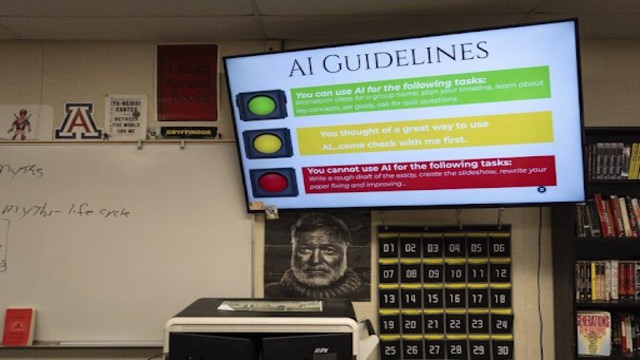
AI guidelines aim to help schools balance learning tools and academic integrity in classrooms. (AP Photo)
The traditional book report is disappearing. Take-home essays and tests are losing their place.
Across the country, high school and college teachers report that student use of artificial intelligence is now so widespread that assigning writing outside the classroom often feels like inviting cheating.
“The cheating is off the charts. It’s the worst I’ve seen in my entire career,” says Casey Cuny, an English teacher with 23 years of experience. “Anything you send home, you have to assume is being AI’ed.”
AI is no longer a tool students might occasionally use—it’s become part of daily learning. This shift is forcing educators to rethink teaching methods and assessment standards.
Blurred Lines Between Help and Cheating
As AI tools like ChatGPT become more advanced, students and teachers alike are struggling to define what counts as academic dishonesty.
“We have to ask ourselves, what is cheating?” Cuny says. “The lines are getting blurred.”
At Valencia High School in Southern California, Cuny now has students do most of their writing in class. He uses software to monitor and restrict laptops, ensuring students don’t access unauthorized resources. He’s also teaching students how to use AI responsibly, showing them how it can support learning rather than replace it.
Similarly, rural Oregon teacher Kelly Gibson has shifted to in-class writing and more verbal assessments. “I used to give a writing prompt and say, ‘In two weeks I want a five-paragraph essay,’” she explains. “These days, I can’t do that. That’s almost begging teenagers to cheat.”
AI Makes Even Simple Assignments Tricky
Take a typical high school essay on *The Great Gatsby*. Many students now start by asking ChatGPT to brainstorm ideas. Within seconds, AI can suggest topics, quotes, and even draft paragraphs. The temptation is immediate and powerful.
Students themselves are often unsure when AI use crosses the line. College sophomore Lily Brown uses ChatGPT to outline essays and summarize difficult readings. “Sometimes I feel bad,” she admits. “Is this cheating? Is asking for help forming an outline cheating?”
Policies often add to the confusion. Some teachers allow AI grammar tools, while others forbid them completely. Valencia 11th grader Jolie Lahey says classroom rules are inconsistent. “It’s such a helpful tool. If we’re not allowed to use it, it feels outdated.”
AI in Education: Schools Shift From Bans to Guidelines
Initially, many schools banned AI after the launch of ChatGPT in late 2022. But views have changed. Today, educators are emphasizing “AI literacy”—teaching students to balance AI’s benefits with its risks. Appreciating AI in education.
Universities are drafting clearer policies. Some recommend specific syllabus statements, indicating whether AI is required, partially allowed, or banned. This clarity helps prevent unintentional misuse.
At Carnegie Mellon University, academic violations linked to AI have risen sharply, often because students aren’t aware they’ve crossed a line. For instance, one English learner used an AI translation tool to convert homework from their native language, unaware the tool altered the wording.
Enforcing rules is difficult. AI-generated work can be hard to detect and even harder to prove. Faculty are now cautious about accusing students unfairly, while students worry about being wrongly flagged.
Redesigning Learning and Assessment
Many educators are rethinking assignments entirely. Take-home essays are replaced with in-class work. Some have returned to pen-and-paper tests. Others use “flipped classrooms,” doing homework tasks in class under supervision.
Emily DeJeu, a business school instructor, replaced writing homework with in-class quizzes on lockdown browsers. “Expecting an 18-year-old to exercise great discipline is unreasonable,” she says. “It’s up to instructors to put up guardrails.”
As AI reshapes education, schools are walking a fine line. They must embrace innovation while protecting academic integrity—and teach students how to navigate the new world responsibly.