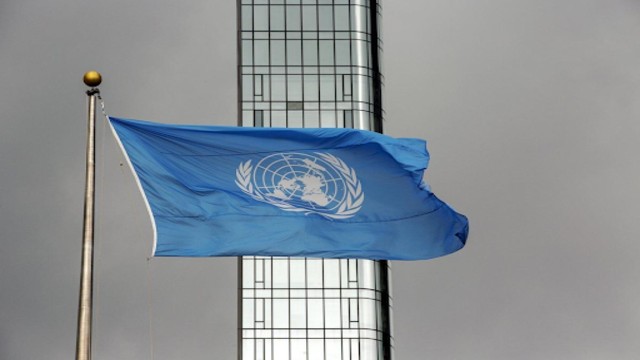
The UN flag flies on a stormy day at the United Nations during the United Nations General Assembly, Sept. 22, 2022. (AP Photo).
Artificial intelligence has officially joined the ranks of global challenges that world leaders are preparing to confront. AI will be discussed alongside issues of security, climate change, and international peace at this week’s United Nations (UN) high-level meeting.
The surge of interest comes nearly three years after ChatGPT ignited the AI boom. Its rapid evolution has both impressed and unsettled governments worldwide. While tech giants race to build more advanced systems, experts continue to warn about risks ranging from disinformation to engineered pandemics.
UN Steps Toward Global Oversight
Last month, the UN General Assembly took a milestone step by adopting a resolution to establish two new AI bodies. The first is a global forum to enable cooperation among governments and stakeholders. The second is an independent scientific panel of experts tasked with guiding risks and best practices.
The forum, named the Global Dialogue on AI Governance, will be officially launched on Thursday by UN Secretary-General António Guterres. It is expected to begin formal sessions in Geneva next year and in New York in 2027. Recruitment will also begin soon for the expert panel. A total of 40 members will be appointed, including two co-chairs — one from a developed country and one from a developing nation.
According to Isabella Wilkinson, a research fellow at Chatham House, the initiative is “the most globally inclusive approach to governing AI so far”. However, she also cautioned that these bodies may lack real authority, raising doubts about whether the UN can keep pace with a rapidly advancing technology.
Security Council Debate
On Wednesday, the UN Security Council will hold an open debate dedicated to AI. Expected key questions: How can AI be applied responsibly in line with international law? And how can it support peace processes and conflict prevention rather than undermining them?
This marks the most direct engagement yet by the Council with the potential global security implications of AI.
Calls for Binding Agreements
Ahead of the discussions, a group of leading AI researchers and executives called for urgent international action. They urged governments to establish clear “red lines” for AI development and deployment, with binding agreements to be adopted by the end of next year.
The group includes senior figures from OpenAI, Google’s DeepMind, and Anthropic. They argue that the world has managed to agree on treaties banning nuclear tests, outlawing biological weapons, and protecting the oceans — and that AI should be no different.
“The idea is simple,” said Stuart Russell, professor of computer science at the University of California, Berkeley. “As with medicines or nuclear power plants, developers should prove safety as a condition for market access.”
Russell suggested the UN could adopt a governance model similar to the International Civil Aviation Organization, which coordinates with regulators worldwide to ensure safety standards are consistent. He also recommended that diplomats consider a flexible “framework convention” that can adapt to rapid technological advances, rather than rigid, outdated rules.
A Defining Challenge
AI has been described as both an extraordinary tool and a potential existential threat. With the UN now placing it firmly on the global agenda, world leaders face the challenge of ensuring that innovation continues without undermining human safety and security.
As the week’s meetings unfold, the debate is no longer whether AI should be governed — but how quickly the world can agree on rules strong enough to matter.