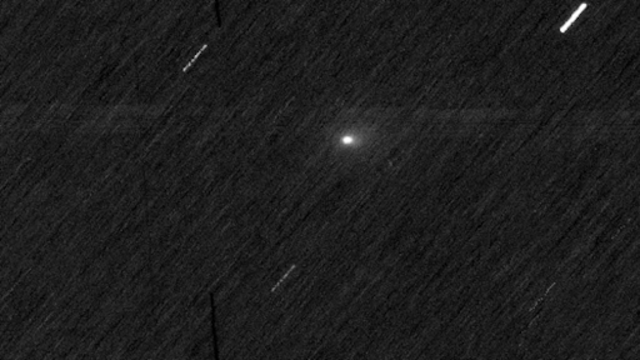
An image of comet 3I/Atlas captured by the ExoMars Trace Gas Orbiter. (ESA/TGO/CaSSIS)
The European Space Agency (ESA) has released new images of a rare and mysterious interstellar comet known as 3I/Atlas. The object, which came from far beyond our solar system, is only the third of its kind ever discovered.
Captured by the ExoMars Trace Gas Orbiter — a satellite jointly operated by the ESA and Russia — the images provide the clearest view yet of this cosmic traveller. The comet passed closest to Mars on October 3, flying within 29 million kilometres of the planet while travelling at an astonishing speed of 310,000 kilometres per hour.
In the photos, the comet appears as a faint, glowing white dot set against the black backdrop of space.
A Difficult Observation from Mars Orbit
Scientists say photographing 3I/Atlas was no easy task. The satellite’s camera, designed to capture detailed images of Mars’ bright surface, had never been used to photograph such a dim and distant object.
“This was a very challenging observation for the instrument,” said Nick Thomas, principal investigator of the ExoMars camera system. “The comet is around 10,000 to 100,000 times fainter than our usual target.”
Despite the difficulty, the successful image gives astronomers a valuable chance to study a visitor from beyond our solar neighbourhood.
What Makes 3I/Atlas Special
Like most comets, 3I/Atlas is thought to have a solid core made of ice, rock, and dust. When it gets close to the sun, the heat causes the ice to vaporize, creating a glowing halo known as a coma and a long tail of gas and dust.
While the tail doesn’t appear in the new photos, scientists expect it to become visible as the comet continues to heat up while moving toward the sun.
Astronomers first spotted 3I/Atlas in July using a telescope in Chile. They believe it could be around three billion years older than our solar system, making it possibly the oldest comet ever seen. It will reach its closest point to the sun at the end of October before turning back toward Earth. In December, it will come within about 269 million kilometres of our planet but poses no danger.
A Rare Interstellar Object
Before 3I/Atlas, only two interstellar objects had been confirmed — Oumuamua in 2017 and Borisov in 2019. Scientists say the comet’s unusual, hyperbolic orbit proves it originated from outside the solar system.
Observations from NASA’s Hubble Space Telescope suggest the comet’s nucleus may range between 440 metres and 5.6 kilometres wide. ESA’s Mars Express spacecraft also tried to photograph the comet but couldn’t capture a clear image.
ESA scientist Colin Wilson said, “It’s always exciting to see our orbiters used in unexpected ways like this. I look forward to what further analysis will show.”
While some people have speculated that 3I/Atlas might be alien technology, astronomers maintain there’s no evidence for that claim.
Scientists across the world will continue to track the comet using advanced observatories, including the James Webb Space Telescope. As the ESA explained, “Interstellar comets are true outsiders, carrying clues about the formation of worlds far beyond our own.”