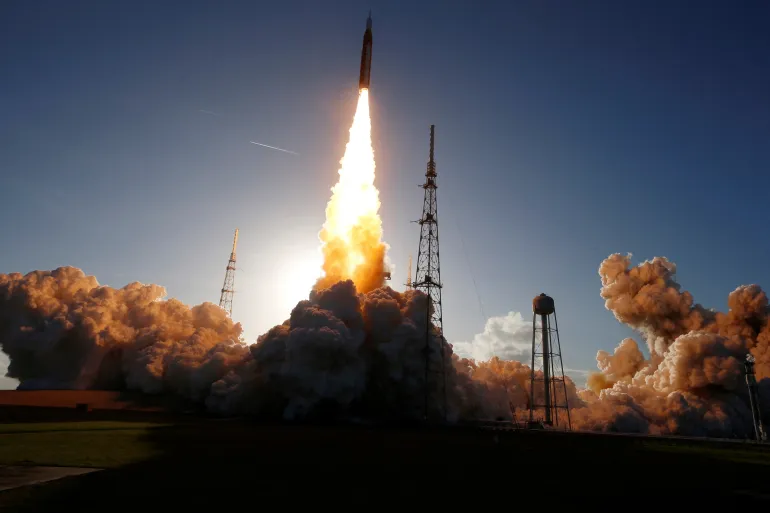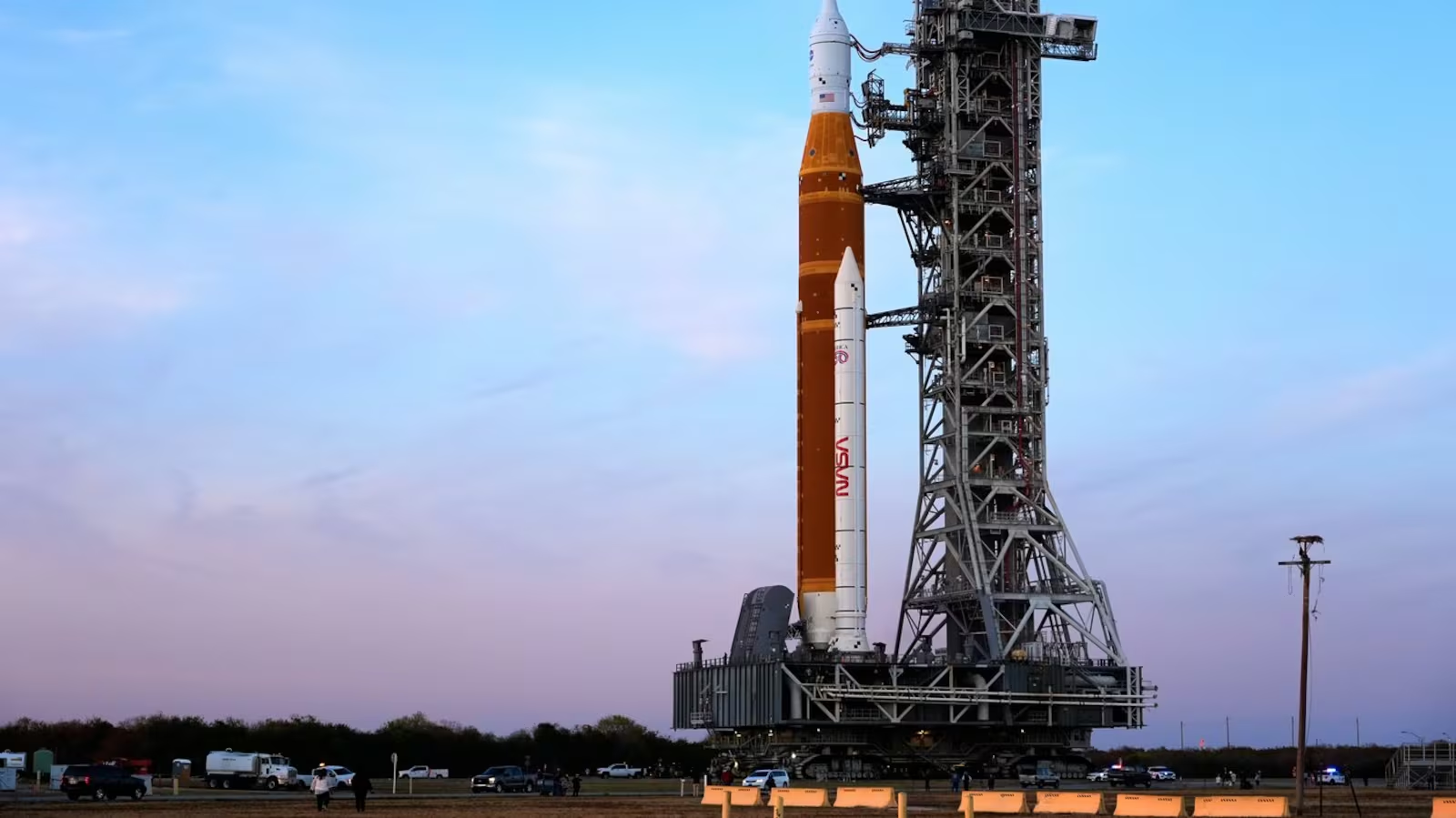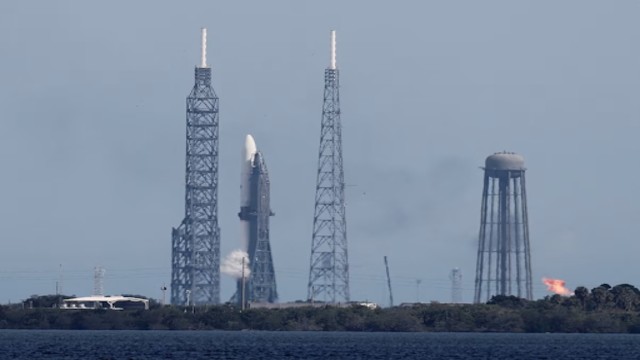
A Blue Origin New Glenn rocket is fueled for launch with NASA's Escapade mission at the Cape Canaveral Space Force Station in Florida on November 9. Image: Reuters
Jeff Bezos’ ambitious Mars mission has hit a temporary snag. Blue Origin’s towering New Glenn rocket, designed to rival SpaceX’s Falcon series, was grounded on Sunday due to thick cloud cover over Cape Canaveral, Florida.
The rocket was scheduled to launch during an 88-minute window that opened at 2:45 p.m. ET. But minutes before liftoff, Blue Origin announced that unfavorable weather conditions had forced a delay. Clouds can pose serious risks during takeoff, especially if they’re electrically charged — a factor that can trigger lightning strikes.
In a brief social media statement, the company said, “We’re reviewing opportunities for our next launch attempt based on forecasted weather.”
Monday Attempt Uncertain Amid FAA Restrictions
Blue Origin had hoped to retry the launch on Monday, with a new window between 2:40 and 4:08 p.m. ET. But forecasts show conditions may not improve. “The weather looks somewhat consistent with Sunday’s,” confirmed Laura Maginnis, Blue Origin’s vice president of mission management, during a weekend press conference.
Adding to the challenge, the Federal Aviation Administration (FAA) announced a halt to commercial rocket launches between 6 a.m. and 10 p.m. ET starting Monday. The move aims to ease pressure on air traffic controllers affected by the ongoing government shutdown.
“We’re working closely with our partners at the FAA and NASA to respect airspace limits,” Maginnis said.
Blue Origin Aims to Reuse Rocket Boosters — A Big Test for New Glenn
Standing at 322 feet (98 meters), New Glenn represents Blue Origin’s entry into the orbital launch market — a space dominated for years by SpaceX. This flight marks New Glenn’s second-ever attempt, carrying two NASA satellites on a historic journey to Mars.
Blue Origin is also looking to achieve another major goal — safely landing and recovering the rocket’s first-stage booster on a drone ship named Jacklyn. Like SpaceX’s reusable Falcon rockets, New Glenn is designed to be partly reusable, cutting costs for future missions.
The company’s first orbital attempt in January was only partially successful. While the rocket successfully deployed a test satellite named Blue Ring Pathfinder into orbit, its booster failed to relight its engines during re-entry and missed its target.
Upgrades and a Second Chance
After months of investigation and adjustments, Blue Origin says it has made key technical improvements. “We’ve incorporated several changes to our propellant management system and minor hardware upgrades to improve our chances of landing the booster,” Maginnis said.
She added that while booster recovery remains important, the mission’s main focus is the payload delivery. “If we don’t land the booster — that’s OK. We have several more vehicles in production,” she assured.
The company hasn’t disclosed the number of boosters currently being built. However, Blue Origin’s next flight, expected later this year, aims to deliver its Mark 1 lunar lander to the moon — another major step for Bezos’ space venture.
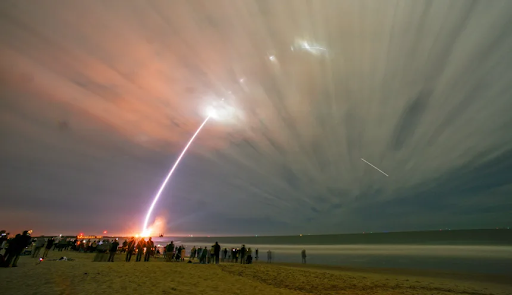
A Blue Origin New Glenn rocket lifts off on its inaugural launch at the Cape Canaveral Space Force Station in Florida on January 16. Reuters
NASA’s Escapade Mission: A New Chapter for Mars
The current mission, named Escapade (short for Escape and Plasma Acceleration Dynamics Explorers), is a joint NASA and University of California, Berkeley project. Supported by commercial partners Advanced Space and Rocket Lab, it’s a low-cost yet groundbreaking planetary science mission.
Once launched, New Glenn will send twin satellites on a long journey toward Mars. They’ll first orbit Earth before heading to the red planet next year, when planetary alignment will allow a more fuel-efficient path.
If successful, the orbiters will reach Mars in 2027. Their task: to study how the planet lost its atmosphere billions of years ago and how solar storms could impact future human explorers.
“We’ll gather vital space weather data to forecast radiation storms that might endanger astronauts on Mars,” explained principal investigator Robert Lillis from UC Berkeley’s Space Sciences Laboratory.
A Brief Delay, But a Bold Future
While Sunday’s postponement is disappointing, the mission remains one of Blue Origin’s most significant milestones yet. For Jeff Bezos’ space company, New Glenn isn’t just another rocket — it’s a statement of intent in the race toward Mars and beyond.
As the weather clears over Florida, the world watches closely for Blue Origin’s next attempt — and a chance to take another giant leap toward interplanetary exploration.