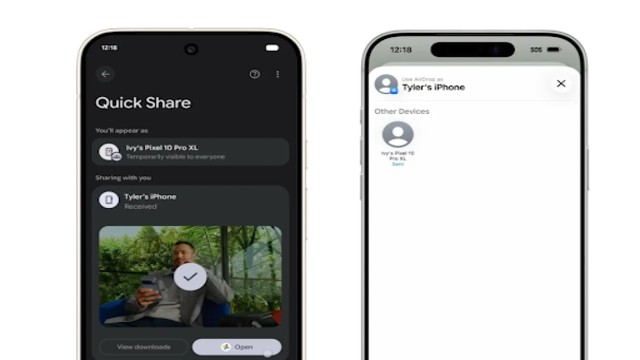
Wireless file transfers between Android and iPhone are here, with Quick Share starting to become AirDrop-compatible. Credit: Google
Google Breaks a Longtime Barrier
Google has quietly pulled off something many thought impossible. The company has unlocked Apple’s AirDrop technology—without Apple’s help—and is rolling it out to the Pixel 10 series. Pixel users can now send and receive files directly with iPhones, iPads and Macs through seamless, peer-to-peer transfers.
This unexpected announcement marks one of the most significant steps toward true cross-platform sharing in years. For Android users long shut out of Apple’s closed ecosystem, the move feels almost revolutionary.
How the New Sharing Works
Sending a file from a Pixel 10 to an Apple device requires one important step from the recipient. The iPhone, iPad or Mac owner must briefly make their device discoverable to everyone. Apple already offers this setting with an automatic 10-minute limit.
Once enabled, the Pixel 10 detects the Apple device through Google’s Quick Share interface. From there, the transfer appears on the Apple device just like any standard AirDrop request. The user only needs to approve it.
The process works in reverse as well. The Pixel 10 must be set to receive from anyone, or placed in active receive mode. The Apple user initiates an AirDrop transfer, the Pixel user accepts, and the file moves instantly between devices.
A Direct, Server-Free Connection
In a detailed post on its security blog, Google revealed how the system was engineered. The company emphasizes that this is not a workaround or hack. The connection between devices is direct and peer-to-peer. No Google or Apple servers route the data. Nothing is stored. No transfer is logged.
The post states, “Your data is never routed through a server, shared content is never logged, and no extra data is shared.” To reinforce confidence, Google commissioned an independent penetration test by security firm NetSPI, which validated the system’s safety.
Built Without Apple’s Help
Google confirmed the breakthrough came without Apple’s involvement. Company spokesperson Alex Moriconi told The Verge that Google built the feature entirely on its own. He added that the solution went through rigorous internal privacy checks before an outside firm was brought in.
When asked how Apple might respond, Google offered a diplomatic answer. The company said it “always welcomes collaboration opportunities” to improve interoperability between iOS and Android. Apple has not yet commented.
A Major Shift in the Ecosystem
For now, the feature is exclusive to the Pixel 10 lineup. But Google says this is only the starting point. “We’re bringing this new experience to Pixel 10 first before expanding to other devices,” Moriconi noted—hinting that more Android phones will gain AirDrop compatibility in the future.
AirDrop has long been one of Apple’s strongest ecosystem advantages. The feature allows near-instant sharing between its devices and has remained locked within its “walled garden.” Google’s breakthrough challenges that exclusivity for the first time in a meaningful way.
The move also comes at a moment of growing convergence between the two mobile giants. RCS messaging is now supported on iPhones, removing another longstanding barrier between platforms. Cross-device file sharing could represent the next large step in that direction.
What Comes Next
Whether Apple embraces or resists this development remains to be seen. But the technical groundwork is already in place. Pixel 10 users can share with Apple devices starting today, with no additional apps or complex setup.
For Android owners accustomed to struggling with file transfers between ecosystems, this is a milestone. For Apple, it could signal increasing pressure to open its ecosystem further.
Either way, Google has just changed the dynamics of cross-platform communication—and it may be only the beginning.