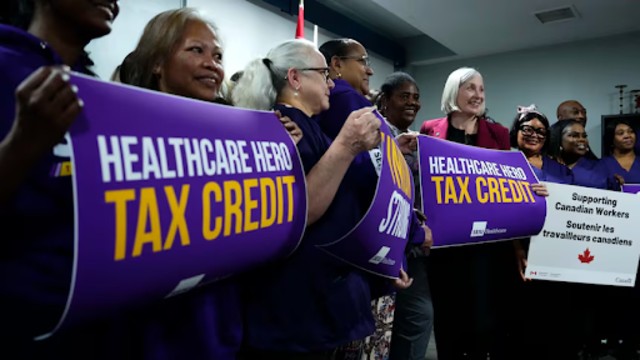
Minister of Jobs and Families Patty Hajdu is seen posing for photos with personal support workers after announcing a specialized tax credit last year. (The Canadian Press)
Canadians heading into 2026 can expect a relatively quiet tax year, with modest adjustments rather than sweeping reforms. While a few measures offer incremental relief, experts say most households will notice little difference in their overall tax burden.
Daniel Rogozynski, an accountant and professor at the University of Waterloo, summed up the coming changes bluntly, calling them largely uneventful. After months of anticipation, he said, the federal government delivered continuity instead of game-changing reform.
Lowest Tax Rate Cut Takes Full Effect
The most visible change in 2026 is the full implementation of a one-percentage-point cut to the lowest federal income tax rate. Income up to $58,523 will now be taxed at 14 per cent, down from 15 per cent previously.
Because the measure was introduced halfway through 2025, last year’s savings were partial. This year marks the first time Canadians will feel the full impact. Federal estimates suggest a maximum annual saving of $840 for two-income households, though some analysts put the average benefit closer to $750.
Tax Brackets Adjust for Inflation
Federal income tax brackets will rise by two per cent in 2026 to reflect inflation. The adjustment is smaller than in recent years but helps prevent bracket creep, where inflation pushes earners into higher tax rates without real income growth.
The top federal tax rate remains unchanged at 33 per cent for income above $258,483. Provincial tax brackets will continue to apply separately.
Temporary Credit for Personal Support Workers
The federal budget introduces a new refundable tax credit for personal support workers, worth five per cent of eligible earnings to a maximum of $1,100 per year.
The credit applies from 2026 to 2030 and is available to workers providing direct, one-on-one care in regulated health-care settings. Workers in British Columbia, Newfoundland and Labrador, and the Northwest Territories are excluded due to existing federal-provincial wage agreements.
Capital Gains Rules Simplified
After years of uncertainty, capital gains rules have been clarified. The lifetime exemption for selling eligible small business shares, farms or fishing properties has increased to $1.25 million and applies retroactively to June 2024.
Earlier proposals to raise capital gains inclusion rates were abandoned before the 2025 federal election, easing concerns among business owners and investors.
CPP Contributions Continue Rising
Enhanced Canada Pension Plan contributions enter their third year in 2026. The maximum pensionable earnings ceiling rises to $74,600, increasing the maximum employee contribution to just over $4,230. Employers are required to match that amount.
A second earnings ceiling also applies, adding a smaller contribution on income up to $85,000.
EI Premiums and TFSAs
Employment insurance premiums will increase slightly, with the maximum annual employee contribution rising to $1,123. Employers will again contribute 1.4 times the employee amount.
The Tax-Free Savings Account contribution limit remains unchanged at $7,000 for 2026. Basic personal exemption amounts have been adjusted modestly for inflation.
A Year of Continuity
Taken together, the 2026 tax changes signal stability rather than disruption. For most Canadians, the year ahead will bring predictable deductions, familiar thresholds and only minor shifts in take-home pay.