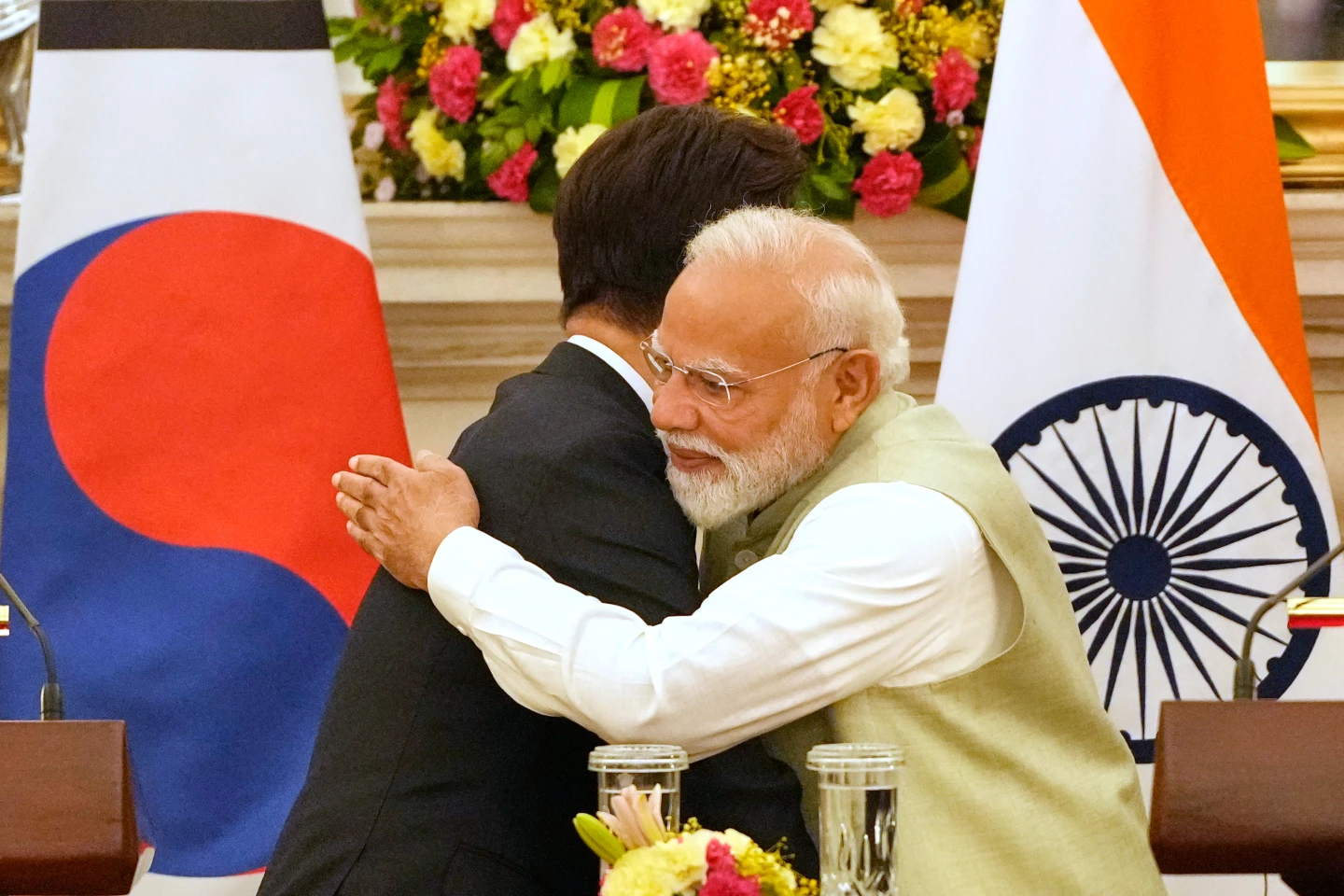
Indian Prime Minister Narendra Modi hugs South Korean President Lee Jae Myung, left, after the signing of memorandum of understanding and agreements.
India and South Korea have agreed to significantly expand their economic partnership, setting an ambitious goal to raise bilateral trade to $50 billion by 2030. The announcement came after talks in New Delhi between Indian Prime Minister Narendra Modi and South Korean President Lee Jae Myung, as both nations seek stronger cooperation during a period of global uncertainty.
The renewed commitment reflects a shared desire to deepen strategic and commercial ties while reducing risks linked to supply chain disruptions and shifting geopolitical conditions.
India South Korea Trade Talks Focus on Growth
During the high-level meeting, both leaders emphasized the importance of strengthening the India South Korea trade relationship through broader market access, investment, and industrial cooperation. Current trade between the two countries stands at around $27 billion, meaning the new target would nearly double existing volumes within the next few years.
Prime Minister Modi described the partnership as one built on trust and prepared for the future. He said both countries aim to transform long-standing relations into a more advanced and forward-looking collaboration.
The discussions also highlighted the need for resilient economic partnerships as businesses worldwide face rising uncertainty caused by conflict, inflation pressures, and logistics challenges.
Strategic Sectors Drive Future Cooperation
A major focus of the India South Korea trade agenda is cooperation in high-value industries that can deliver long-term benefits to both economies. President Lee said the two nations agreed to expand work in sectors such as shipbuilding, defense, and artificial intelligence.
In addition, both governments plan to encourage investment in advanced manufacturing and industrial innovation. These areas are expected to play a central role in supporting future growth while creating stronger production networks between the two countries.
Sensitive sectors including critical minerals and nuclear energy were also discussed, signaling a broader strategic dimension to the economic partnership.
Supply Chain Security Gains Importance
The India South Korea trade push comes at a time when many countries are reassessing supply chain security. Global markets have faced repeated shocks in recent years, and recent tensions in the Middle East have added fresh concerns over energy and shipping routes.
As part of efforts to diversify supply sources, South Korea plans to increase imports of naphtha from India. Naphtha, a petroleum derivative widely used in petrochemicals and industrial processes, is considered an important raw material for manufacturing.
India already supplies a share of South Korea’s naphtha needs, and higher imports could help Seoul reduce exposure to external disruptions while strengthening commercial ties with New Delhi.
Stronger Partnership in a Changing Global Economy
The expanded India South Korea trade vision reflects how both countries are positioning themselves in a rapidly changing global economy. India continues to attract international interest as a major manufacturing and consumption market, while South Korea remains a global leader in technology, engineering, and industrial expertise.
By combining these strengths, both nations see an opportunity to build a more balanced and diversified partnership. Increased trade, technology exchange, and strategic cooperation could also enhance their influence in the wider Indo-Pacific region.
India South Korea Trade Outlook Remains Positive
The new $50 billion target signals confidence in the long-term potential of the relationship. While reaching that goal will require sustained policy support and private-sector participation, both leaders indicated strong political commitment to making it happen.
As President Lee concludes his India visit before traveling to Vietnam, the meeting marks an important step in expanding regional partnerships. For India and South Korea, the agreement sets the stage for stronger trade flows, deeper industrial links, and a more resilient economic future.