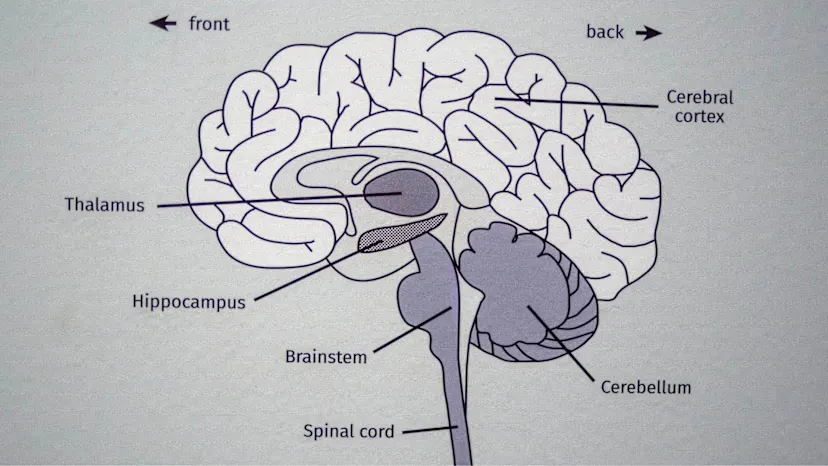
Image of a brain with labeled parts of the brain.
A new study on cognitive decline is offering fresh hope by challenging the long-held belief that brain aging is irreversible. Researchers have identified a single protein that appears to drive memory loss and cognitive dysfunction, raising the possibility that age-related decline could one day be treated or even reversed.
Cognitive Decline Linked to Key Brain Protein
Scientists at the University of California, San Francisco closely examined how the brain changes with age, focusing on the hippocampus, the region responsible for memory and learning. Their findings revealed that older brains contained significantly higher levels of a protein known as FTL1.
To understand whether FTL1 was merely associated with aging or directly responsible for cognitive decline, researchers conducted controlled experiments. When they increased levels of this protein in younger mice, their brains began to exhibit characteristics typically seen in older subjects.
Neural connections became less complex, and communication between brain cells weakened noticeably. These changes mirrored the early stages of cognitive decline, suggesting that FTL1 plays a direct role in disrupting brain function.
Reversing Cognitive Decline Shows Promising Results
The most striking discovery came when scientists reduced FTL1 levels in older mice. Instead of simply slowing the progression of cognitive decline, the intervention appeared to reverse existing damage.
Neurons regained their ability to form complex networks, and brain connectivity improved significantly. These biological changes translated into better performance in memory-based tasks, indicating a measurable recovery in cognitive function.
Researchers described this outcome as more than a preventative measure, highlighting that the brain showed signs of genuine repair rather than temporary improvement.
How FTL1 Disrupts Brain Function
Further analysis revealed how the protein contributes to cognitive decline at a cellular level. Elevated FTL1 levels interfere with energy production inside brain cells, effectively limiting their ability to function efficiently.
As energy levels drop, neurons struggle to maintain strong synaptic connections, which are essential for memory and learning. Over time, this leads to the gradual breakdown of communication pathways within the brain, accelerating cognitive decline.
By restoring normal protein levels, scientists were able to remove this metabolic barrier, allowing brain cells to regain their activity and rebuild lost connections.
Future Implications for Treating Cognitive Decline
While the research is still in its early stages, the findings open new possibilities for treating cognitive decline in humans. Developing therapies that target FTL1 could potentially transform how age-related brain conditions are managed.
Although clinical applications may take time, the study shifts the scientific perspective on brain aging. Instead of viewing cognitive decline as an unavoidable outcome, it may now be considered a biological process that can be modified or even reversed.
This breakthrough not only deepens our understanding of how the brain ages but also offers renewed optimism for future treatments aimed at preserving memory and cognitive health.