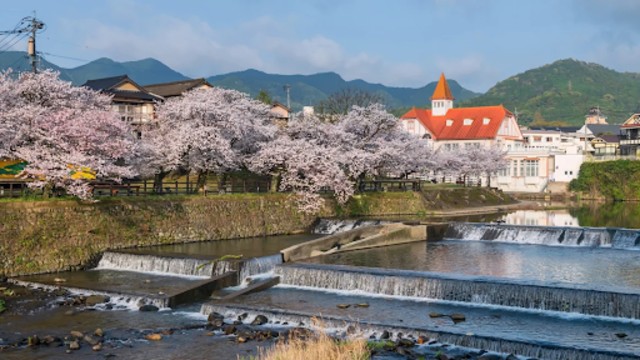
Cherry blossoms bloom around the Siebold no Yu public bath in Ureshino Onsen Park. Getty Images
Japan’s natural hot springs, known as onsens, are famous for their relaxing experience. Travelers from all over the world visit these thermal pools to unwind. However, the growing number of visitors has caused water shortages in several onsen towns, leaving local authorities worried.
One such town is Ureshino, located in the mountains of Saga Prefecture on Japan’s western island of Kyushu. This town is home to over 30 hotels and traditional inns, attracting tourists for its highly sought-after onsens. Previously popular among domestic travelers, Ureshino has seen a surge in international visitors.
Local officials have raised concerns about the increasing demand for onsen water. Deputy Mayor Hironori Hayase said that tourism has grown significantly since the pandemic, leading to higher water consumption at hotels and ryokans.
Reports indicate that Ureshino’s average water level dropped to 39.6 meters (130 feet) last year, marking a 20% decline from four years ago. Despite this, Mayor Daisuke Murakami assured that the water source remains sustainable. However, officials have asked hotels to limit private in-room onsen usage, especially during late-night hours.
Private onsens are especially popular among foreign tourists who prefer privacy over communal baths. In traditional onsen culture, visitors must bathe naked in shared pools, a practice that many international travelers are uncomfortable with. While communal onsens charge as little as $3, private onsens can cost hundreds of dollars per night, leading to increased water demand.
Mayor Murakami emphasized the importance of preserving the town’s tourism industry. “Ureshino depends on tourism, and we will take all necessary measures to protect it,” he said.
Onsens are not just a cultural experience but are also believed to offer health benefits. Bathing in these mineral-rich waters is said to relieve stress, improve skin conditions, and relax muscles. However, not every hot pool qualifies as an onsen. Japanese law requires onsen water to be naturally heated by underground thermal energy and to maintain a temperature of at least 25°C (77°F) at the surface. It must also contain specific minerals.
The problem is not limited to Ureshino. Researcher Akihiro Otsuka from the Chuo Onsen Research Institute noted that several famous onsen areas across Japan are struggling with water shortages. In Niseko, a popular destination in Hokkaido, water levels have dropped by 15 meters (49 feet) in the past three years.
Otsuka pointed out that tourism is not the only reason for these shortages. Many onsen towns are dealing with aging infrastructure, including corroded pipes and outdated pumping systems, which contribute to water loss. “Many onsens have old facilities that have not been properly maintained,” he said.
Even onsens without water shortages face another issue—overcrowding. In Ginzan Onsen, a historic hot spring town north of Tokyo, officials have begun limiting entry during peak seasons to manage tourist impact.
As Japan’s tourism industry continues to boom, balancing visitor demand and natural resource conservation remains a growing challenge.