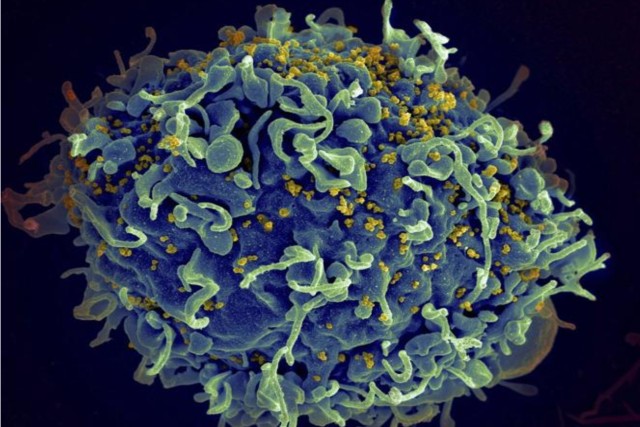
Colorized electron microscope image provided by the U.S. National Institutes of Health shows a human T cell, in blue, under attack by HIV, in yellow, the virus that causes AIDS. (National Institute of Allergy and Infectious Diseases/NIH via AP)
A global health emergency is brewing, and it's flying under the radar. The United Nations has issued a grave warning: millions of lives could be lost by 2029 if the U.S. doesn’t restore its financial support for global HIV programs.
For two decades, American-led aid efforts helped bring AIDS-related deaths to historic lows and offered hope to the world’s most vulnerable. Now, that progress is on the brink of collapse.
The Sudden Pullback That Shocked the System
In January, the U.S. abruptly withdrew $4 billion in promised aid for the global HIV response. This wasn’t a slow phase-out. The funding disappeared virtually overnight.
The decision came as part of a broader freeze on foreign aid by President Donald Trump, who later moved to shut down USAID, America’s main development agency. Health systems across Africa and other low-income regions were left stunned and scrambling.
In a new report, UNAIDS described the result as a “systemic shock.” Clinics closed. Staff were let go. Testing and prevention programs ground to a halt. Supply chains for life-saving medication were disrupted. Some of the hardest-hit communities had to stop HIV services altogether.
The Stakes: Over 4 Million Deaths
If the funding gap remains unfilled, over 4 million AIDS-related deaths and 6 million new HIV infections are expected by 2029.
The world had made major strides: from a peak of 2 million AIDS deaths in 2004 to 630,000 in 2024. But even before the U.S. pulled its support, progress had slowed. Sub-Saharan Africa continues to bear half of all new HIV cases.
Now, public health officials warn this sudden withdrawal could erase decades of effort.
Why This Loss Hurts So Much
The U.S. program in question is PEPFAR — the President’s Emergency Plan for AIDS Relief — launched by George W. Bush in 2003. It's been the largest single-country investment in tackling one disease and has provided:
HIV testing for over 84 million people
Life-saving treatment for more than 20 million
99.9% of HIV prevention medication funding in countries like Nigeria
UNAIDS called it a “lifeline.”
But without warning or backup plans, nations were left exposed. “Any responsible government would have given advance notice,” said Andrew Hill, an HIV researcher from the University of Liverpool.
No One Can Fill the Gap
Some lower-income nations have tried to fund their own programs, but the reality is harsh. They can't replace U.S. support, says Tom Ellman of Doctors Without Borders.
And it’s not just funding that vanished — it’s critical data, too.
The U.S. financed most HIV surveillance systems across Africa. Now those systems are dark, and experts fear they’ve lost track of how the virus is spreading.
“Without data,” said Dr. Chris Beyrer of Duke University, “it’s nearly impossible to stop HIV.”
A New Drug, But an Uncertain Future
Ironically, all this is happening just as science offers real hope. A new injectable HIV drug—approved by the U.S. FDA last month—has shown 100% effectiveness in preventing the virus. The drug, Yeztugo by Gilead, could be a game-changer.
South Africa’s health minister called it a breakthrough and promised widespread access. But Gilead's pricing could put it out of reach for many. While the company agreed to offer generics in 120 poor nations, most of Latin America is excluded, despite rising infection rates there.
Peter Maybarduk of Public Citizen summed it up: “We could be ending AIDS. Instead, the U.S. is abandoning the fight.”
Final Word
The world is standing at a turning point. Years of steady progress are now at risk, not because of science or medicine—but because of politics.
The clock is ticking. And without urgent action to restore funding or step up global support, millions could pay the price.