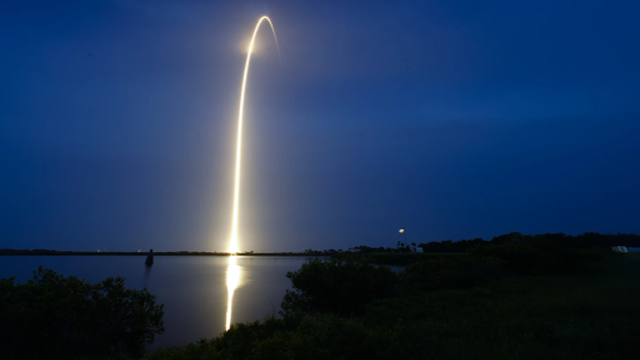
In the Long exposure photo, a SpaceX Falcon 9 rocket with a payload of Starlink v2 Mini internet satellites lifts off from Launch Complex 40 at the CAPE Canaveral Space Force Station in Cape CANAVERAL, fla, late Sunday, July 23, 2025. Associated Press
Beijing is sounding the alarm on Elon Musk’s Starlink, viewing the satellite network as a rising national security threat. Chinese military and government-backed scientists are now devising bold countermeasures—from laser-equipped submarines to cyber sabotage—to tackle what they call a looming space dominance issue.
Starlink Sparks Security Concerns in China
Since 2019, Starlink has launched over 8,000 satellites, delivering high-speed internet across more than 140 countries. While its global reach is impressive, China fears this rapid expansion. Chinese defense experts argue that Starlink is deeply intertwined with U.S. intelligence and military systems.
In several papers, scientists from China’s National University of Defense Technology highlighted Starlink’s potential use in war and surveillance. They believe the satellite network could offer the U.S. a major edge across space, cyber, and nuclear domains.
Military Strategies to Disrupt Starlink
Chinese researchers have gone public with several unconventional proposals to neutralize Starlink’s advantages. These include:
- Submarines with space-targeting lasers
- Attack satellites with ion thrusters
- Space-based systems to release corrosive materials on Starlink units
- AI-generated deep fakes and cyber disruption
- Surveillance using small, commercially available optical telescopes
Another research team suggested using international diplomacy to restrict Musk’s influence through global space regulations. Yet, the focus remains on developing active military countermeasures.
Russia-Ukraine War Intensifies Fears
China’s concerns surged after the Russia-Ukraine war revealed Starlink’s battlefield utility. Ukraine used the network to control drones and maintain communication even in blackouts. Musk’s refusal to extend coverage over Crimea showed just how much influence one individual could wield during wartime.
Beijing saw this as a cautionary tale. Starlink’s flexible control, paired with its strategic value, made it clear: space infrastructure can shape modern conflicts.
SpaceX's Powerful Ties to U.S. Government
SpaceX, the parent company of Starlink, is closely tied to American national interests. It holds contracts worth billions with NASA and the Pentagon. The company also supports U.S. spy satellites and helps rescue astronauts.
These ties, along with Musk’s unpredictable political behavior, worry foreign governments. From promoting controversial political figures to feuding with world leaders, Musk’s influence extends far beyond business.
Starlink's Global Footprint Keeps Expanding
Starlink isn’t just a U.S. asset—it’s rapidly going global. The company recently entered markets like India, Pakistan, Somalia, and Vietnam, overcoming stiff resistance and regulatory barriers.
With few dead zones left—mainly in China, Iran, and North Korea—Starlink has become the world’s most expansive satellite internet provider. Other countries, including U.S. allies, are growing uneasy about its control over critical digital infrastructure.
Global Competition Struggles to Catch Up
Efforts to counter Starlink’s lead are underway. Amazon’s Project Kuiper, the EU’s IRIS2 initiative, and China's own Guowang constellation are racing to close the gap. But the numbers don’t lie: Starlink operates 8,000+ satellites, while Kuiper has 78 and Europe’s OneWeb barely 650.
China’s Guowang system aims to deploy 13,000 satellites. Its first 60 are already in orbit. Another Chinese firm, Qianfan, backed by Shanghai, has launched 90 satellites of a planned 15,000.
Chinese Scientists Monitor and Map Starlink's Weak Spots
Though Starlink does not officially operate in China, its satellites orbit above Chinese territory. Scientists simulated Starlink’s coverage of key regions like Beijing, Taiwan, and the polar areas, finding near-constant satellite presence.
Other studies dug into Starlink’s complex supply chain. With over 140 first-tier suppliers, researchers see room for targeted cyberattacks and supply disruptions to destabilize operations.
Strategic Autonomy Becomes a Priority
Nations around the world are rethinking their reliance on foreign-run satellite systems. EU lawmakers now emphasize the need for “strategic autonomy,” refusing to be at the mercy of companies like Starlink.
As space becomes the new frontier for geopolitics, China’s aggressive stance signals a shift. The next power struggle might not unfold on Earth—but in orbit.