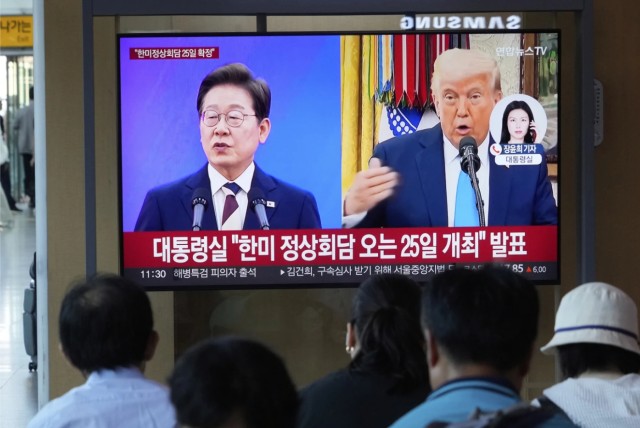
People watch a TV screen showing a file image of South Korean President Lee Jae Myung, left, and US President Donald Trump during a news program at the Seoul Railway Station in seoul, south korea, Tuesday, Aug 12, 2025.
South Korean President Lee Jae Myung will visit Washington on August 25.
He will meet U.S. President Donald Trump for high-level talks.
The agenda includes trade, defense cooperation, and regional security challenges.
North Korea’s nuclear threat will be a central topic.
Trade Deal Sets the Stage for the Summit
The meeting follows a significant trade agreement in July.
Washington agreed to reduce its reciprocal tariff on South Korea to 15%.
This is down from the initially proposed 25% rate.
The same tariff cut applies to South Korean car exports, a major industry for Seoul.
In return, South Korea pledged to buy $100 billion in U.S. energy.
It will also invest $350 billion in the American economy.
Lee and Trump are expected to discuss structuring and managing this investment package.
Key industries like semiconductors, batteries, and shipbuilding are expected to see deeper cooperation.
Lee’s Economic and Strategic Goals
Lee took office in June after winning an early election.
He replaced ousted conservative leader Yoon Suk Yeol.
As a liberal, Lee has made economic stability his top priority.
He aims to protect South Korea’s trade-dependent economy from tariff shocks.
Trump’s past tariff hikes and demands for allies to contribute more to defense costs are a concern in Seoul.
The upcoming talks will seek to strengthen the decades-old U.S.–South Korea alliance.
Lee wants to develop a future-oriented, comprehensive strategic partnership with Washington.
Concerns Over U.S. Troop Presence
Currently, 28,500 American troops are stationed in South Korea.
During his first term, Trump often called for Seoul to pay more for their upkeep.
Some Trump administration officials have hinted at restructuring the alliance.
Experts warn this could reduce U.S. troop numbers and shift more defense responsibility to South Korea.
Such a move might increase Seoul’s costs and risks.
The U.S. could then focus more military resources on countering China.
Modernizing the Alliance for New Threats
General Xavier Brunson, commander of U.S. Forces Korea, recently spoke to South Korean reporters.
He stressed the need to modernize the alliance for evolving security challenges.
These include North Korea’s expanding nuclear arsenal and its closer ties with Russia.
He also pointed to growing Chinese influence in the Indo-Pacific.
Brunson emphasized military capabilities over troop numbers.
He highlighted advanced systems like fifth-generation fighter jets and Patriot missile defenses.
The U.S. has shown strategic flexibility, recently moving air defense systems from Korea to the Middle East.
History of Trump–Kim Diplomacy
During his first term, Trump suspended joint U.S.–South Korea military drills.
He held three meetings with North Korean leader Kim Jong Un in 2018 and 2019.
Talks collapsed over disagreements on lifting sanctions in exchange for nuclear disarmament steps.
Since then, Kim has halted almost all diplomacy with Washington and Seoul.
Instead, he has expanded his weapons program.
He has also strengthened military cooperation with Russia, supplying arms and personnel for the war in Ukraine.
North Korea’s Stance on Diplomacy
Kim’s sister recently dismissed efforts by Washington and Seoul to restart nuclear talks.
Her comments suggest Pyongyang sees no urgency to return to diplomacy.
Upcoming Military Drills Could Raise Tensions
On August 18, the U.S. and South Korea will begin their annual large-scale joint exercises.
North Korea views these drills as invasion rehearsals.
It often responds with missile tests and other military actions.
Analysts warn tensions on the Korean Peninsula could rise in the coming weeks.
The Lee–Trump summit will be closely watched.
Its outcomes could shape the future of U.S.–South Korea relations and regional security.