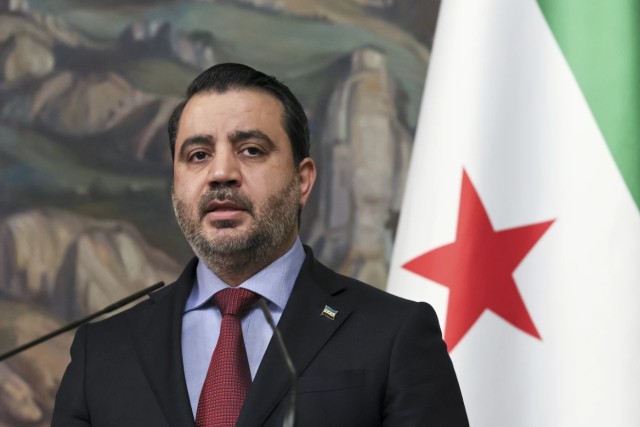
Syrian Foreign Minister Assa Hassan al-Shibani attends a joint news conference with Russian Foreign MInister Sergey Lavrov following their meeting in Moscow, Russia, Tuesday, July 31, 2025.
Syria and Israel held rare direct talks in Paris on Tuesday, signaling a possible shift in decades of hostility. The meeting, confirmed by both Syrian state media and US officials, comes as Washington pushes for Syria-Israel normalization despite deep mistrust and renewed conflict across the region.
Syria’s Foreign Minister Asaad al-Shibani sat down with Israeli delegates to discuss de-escalation and the 1974 ceasefire agreement. That deal created a UN-patrolled buffer zone between the two nations after years of war. However, details of Tuesday’s meeting remain undisclosed.
A senior US official stressed America’s support for peace initiatives, highlighting a “stable Syria at peace with Israel” as part of Washington’s vision for the Middle East.
First Direct Syria-Israel Talks in Decades
While Syrian leaders have previously admitted to indirect contacts with Israel, this is the first publicly acknowledged direct negotiation. Israel, however, has not officially confirmed its participation.
Tensions escalated dramatically after Syrian President Bashar Assad was overthrown last December in a swift insurgent campaign. In the aftermath, Israel expanded its military presence in the UN buffer zone and carried out targeted airstrikes near Damascus.
Israel insists it will not permit hostile groups, including Iranian-backed militias, to regroup near its borders. Syria’s new president, Ahmad al-Sharaa — a former Islamist insurgent — has promised reconciliation and minority rights. Still, sectarian violence remains a major obstacle to Syria’s fragile transition.
Sectarian Violence Deepens the Crisis
Syria’s Sweida province recently became the center of bloody clashes between government forces, Bedouin clans, and armed Druze groups. Allegations of war crimes surfaced after videos showed Druze civilians, including a medic, being killed. Other disturbing clips depicted Druze elders humiliated by fighters.
The unrest prompted Israel to intervene militarily, citing its responsibility to protect Druze communities, many of whom serve in Israel’s military. Dozens of Israeli airstrikes hit Syrian convoys and even targeted Syria’s Ministry of Defense in central Damascus.
This intervention reignited disputes over the Golan Heights, seized by Israel in 1967 and later annexed — a move recognized only by the United States. For most of the world, the Golan remains occupied Syrian territory.
Druze Minority Caught Between Borders
The Druze, a small but influential religious minority, now find themselves trapped between Syrian government forces and regional politics. Syrian troops have surrounded Sweida city, restricting aid deliveries. Locals describe the situation as a siege, with growing humanitarian needs.
For decades, Syrian Druze avoided close ties with Israel. But as conditions worsen, more are considering cooperation with Tel Aviv. Hundreds rallied in Sweida last week, demanding self-determination for the Druze minority, with some protesters waving Israeli flags.
These images sparked outrage across Syria, where many saw them as acts of betrayal. Yet, the protests highlight a growing divide between Druze demands for security and broader Syrian nationalism.
US Diplomatic Push for Syria-Israel Normalization
On the same day as the Paris talks, US envoy to Syria Tom Barrack met Moafaq Tarif, the Druze spiritual leader in Israel. Barrack called it a “warm and informative” meeting focused on security, humanitarian aid, and conflict resolution.
Tarif appealed for American support in lifting the Sweida blockade, securing the release of kidnapped Druze, and guaranteeing community safety.
Washington appears committed to bridging divides. By mediating between Syria, Israel, and minority groups like the Druze, the US hopes to lay the groundwork for Syria-Israel normalization.
A Fragile Path Ahead
The Paris meeting may mark the first step in thawing Syria-Israel relations, but challenges remain immense. Sectarian unrest, disputed territories, and mistrust between new Syrian leadership and Israel continue to complicate progress.
For now, the US is pushing for small victories — reduced tensions, humanitarian relief, and dialogue. Whether these talks lead to real peace or collapse under renewed conflict will shape the region’s future.