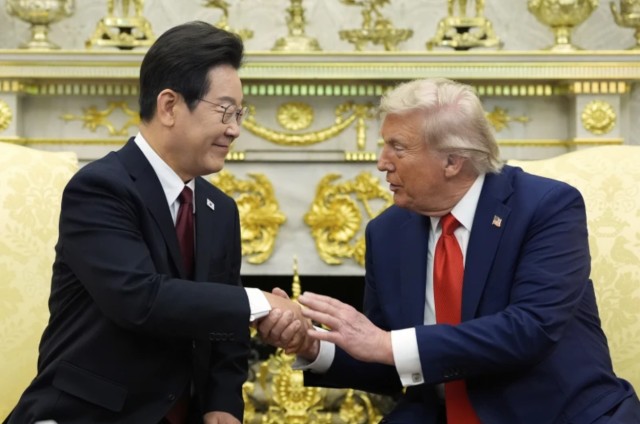
President Donald Trump, right, shakes the hand of South Korean President Lee Jae Myung during a meeting in the Oval Office of the White House, Monday, Aug. 25, 2025, in Washington.
U.S. President Donald Trump began Monday by issuing a stern warning to South Korea’s new leader, President Lee Jae Myung. On social media, Trump threatened to halt cooperation with Seoul, citing what he called a “Purge or Revolution” underway in the country.
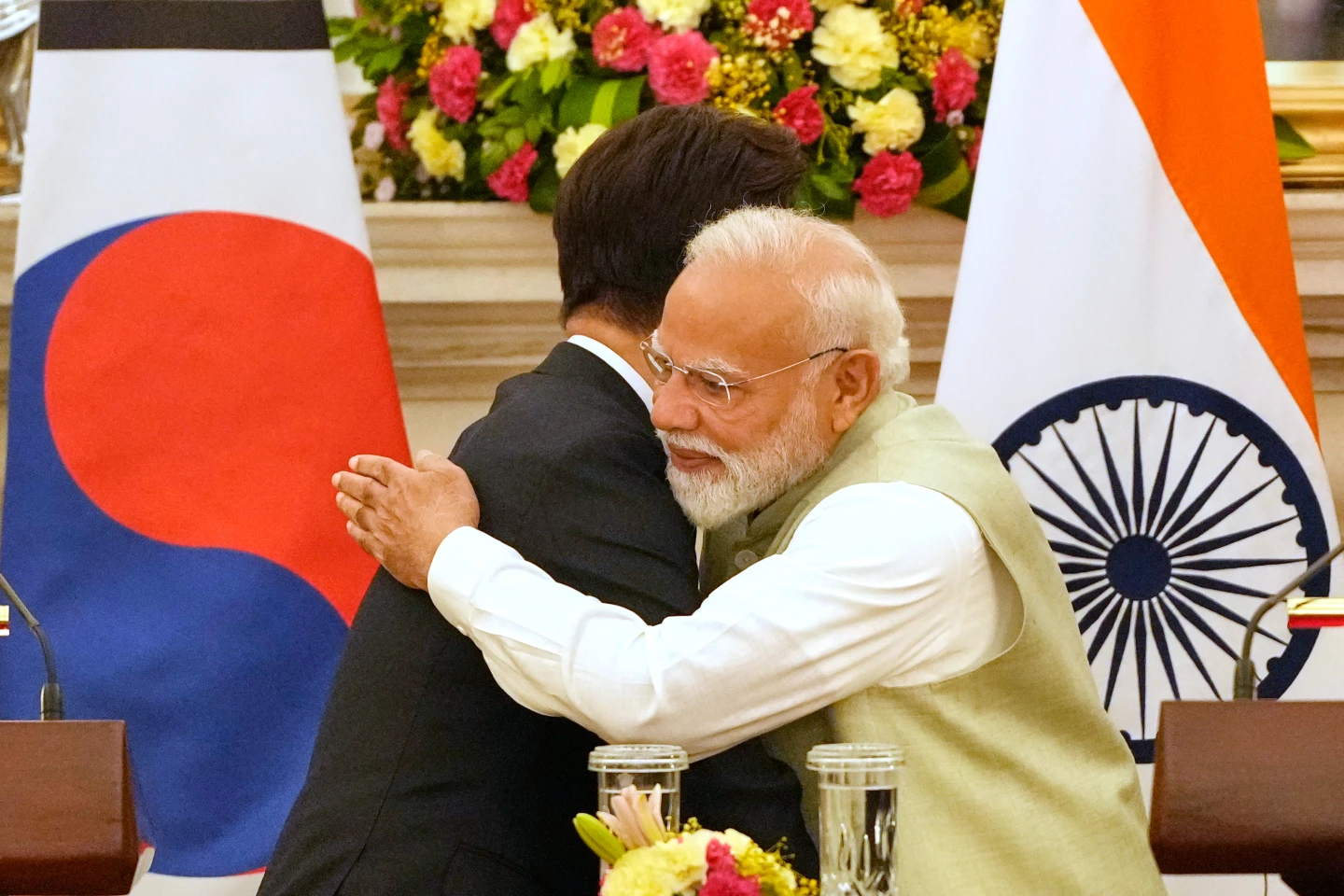
Yet, when the two finally met at the White House, the tense atmosphere quickly disappeared. Praise, charm, and flattery from Lee transformed what could have been a combative encounter into a warm exchange.
From Confrontation to Cordiality
Before stepping into the Oval Office, Trump expressed doubts about South Korea’s political environment. He criticized alleged raids on churches and even a U.S. military base.
But face-to-face, Lee changed the narrative. He admired the Oval Office’s new décor, congratulated Trump on his reelection, and praised his efforts for Korean peace. At one point, he even suggested the idea of a Trump Tower in North Korea.
Trump responded warmly. “It’s a great honor to be with you,” he said. “We’re with you 100%.”
A Strategic Shift in Diplomacy
The exchange revealed a pattern familiar to world leaders dealing with Trump. Rather than confront him directly, many choose to flatter and seek his goodwill. Lee, facing one of his first major foreign policy tests, seemed to take this route.
South Korea has been navigating political upheaval since former President Yoon Suk Yeol was removed from office after imposing martial law. Lee, elected in June, entered the meeting eager to stabilize relations with Washington.
Lee’s Praise for Trump
Through an interpreter, Lee praised the Oval Office’s appearance. He said it symbolized “the dignity of America and its prosperous future.” He also applauded record-high U.S. stock market levels, while noting slight dips.
Lee went further. He urged Trump to continue peace efforts on the Korean Peninsula and even hinted at reunification. Suggesting Trump could build a tower and golf course in North Korea, Lee fueled Trump’s long-standing ambitions for legacy projects.
Calling Trump the “only leader” capable of such achievements, Lee framed him as the key to a Korean “renaissance.”
Political Turmoil in South Korea
Trump’s earlier criticism stemmed from recent investigations in Seoul. Authorities raided churches and facilities tied to corruption scandals involving former First Lady Kim Keon Hee. Investigators also searched sections of Osan Air Base linked to Yoon’s martial law actions.
When pressed by reporters, Trump softened his stance, saying, “It didn’t sound to me like South Korea.” Lee clarified that the raids were part of a special prosecutor’s probe into Yoon’s alleged abuses of power.
The moment turned slightly humorous when Trump asked whether the prosecutor’s name was “Deranged Jack Smith,” referencing his own U.S. legal battles.
The Rise of President Lee
Lee Jae Myung’s rise is remarkable. Once a child laborer with an arm disability, he fought his way into politics and eventually won the presidency. His victory came after repeated attempts and years of leading South Korea’s liberal Democratic Party.
During his Washington trip, Lee admitted Trump’s earlier post worried him, fearing a “Zelenskyy moment.” Still, he insisted the U.S.–South Korea alliance remained strong. Their talks, he said, were “beyond expectations” and lasted longer than planned.
Defense, Trade, and Future Ties
Lee promised Trump that South Korea would boost its defense spending. He pledged to modernize the Korean military into a “smart military” capable of handling future threats.
The leaders also discussed trade. Following a July agreement, Seoul committed billions in U.S. investments, while Trump set tariffs on South Korean goods at 15%—lower than his threatened 25%.
Despite Trump’s complaints about trade deficits, Lee emphasized cooperation. Meanwhile, Trump raised the possibility of scrapping the U.S. lease on Osan Air Base in favor of outright ownership.
What began as a potential clash between Trump and Lee ended in mutual admiration. Lee’s flattering diplomacy defused tension, ensuring that U.S.–South Korea ties remained on stable ground.
For Lee, the meeting was an early test of leadership in turbulent times. For Trump, it was another display of how world leaders have learned that praise often works better than confrontation.