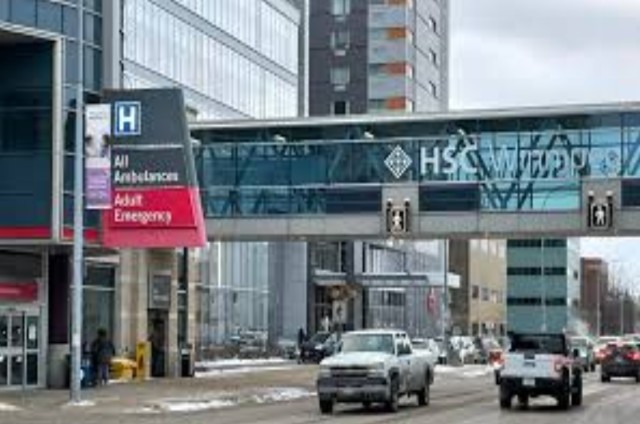
Winnipeg police officers will soon be stationed 24/7 at the Health Sciences Centre in an attempt to address safety concerns.
Winnipeg’s largest hospital is about to see a major security shift. The Health Sciences Centre (HSC) will soon have police officers stationed in its emergency department around the clock. The move comes after a string of troubling safety incidents, growing pressure from health-care unions, and mounting fears among staff and patients.
Police Officers to Be Posted Inside HSC
The Manitoba government confirmed that two Winnipeg Police Service officers will patrol the Health Sciences Centre 24 hours a day, seven days a week. Their focus will be on the emergency department, one of the busiest and most vulnerable parts of the hospital.
At the same time, five new weapon-detection scanners will be installed at hospital entrances, adding another layer of security to existing measures.
A Direct Response to Safety Concerns
The plan to bring in police follows months of heightened tension. Last month, the Manitoba Nurses Union (MNU) took the unusual step of “grey listing” the hospital. The move discouraged nurses from picking up shifts at HSC, citing unsafe conditions for staff.
That decision came shortly after four women and a teenage girl reported being sexually assaulted in or around the hospital grounds in July. For many frontline workers, these incidents confirmed long-standing fears that the facility lacked adequate protection.
Nurses See Move as a “Good First Step”
MNU president Darlene Jackson welcomed the announcement, describing it as a necessary immediate step.
“My hope is that eventually we will have enough Institutional Safety Officers trained and equipped to be what we need for security without having police there,” Jackson said. “But we definitely need to start with police there now.”
Her comments reflect a broader concern among health-care staff: while police presence may be reassuring today, long-term solutions will require better-trained hospital security teams dedicated to health-care environments.
Government Emphasizes Proactive Action
Health Minister Uzoma Asagwara said the province is taking action to protect both patients and providers.
“By funding dedicated police officers within the Health Sciences Centre emergency department, we are taking a proactive step to create a more secure and supportive environment for those seeking care and those providing it,” Asagwara said in a statement.
The minister stressed that hospital staff deserve to feel safe at work, and patients must receive care in an environment free from threats or intimidation.
Troubling Track Record of Violence
The Health Sciences Centre has been at the centre of multiple security concerns in recent years. A Doctors Manitoba survey revealed that 44 percent of physical safety incidents involving physicians over the past year occurred at HSC.
These statistics underline what both doctors and nurses have repeatedly warned: violence in the workplace has become too common in health care.
Existing Security Technology
Since early 2024, HSC has used AI-powered scanners to detect weapons at entrances. While this technology has proven useful, the province now argues that combining it with on-site police patrols will provide a more effective, layered response to threats.
Justice Minister Calls It a “Smart Approach”
Justice Minister Matt Wiebe described the decision as a collaborative step between health care and law enforcement.
“These police officers will create a layered security response structure,” Wiebe said. “It ensures that individuals in crisis continue to receive the care and supervision they need.”
He called the move a “smart approach” that balances security while respecting the hospital’s role as a place of care.
Hope Lingers
For now, the presence of police officers at HSC is being hailed as a necessary measure in response to immediate safety risks. But both union leaders and government officials acknowledge the importance of building long-term solutions—ones that rely on trained hospital security rather than a permanent police presence.
Until then, patients, visitors, and health-care workers at Winnipeg’s busiest hospital will soon see a stronger, more visible line of protection at the doors.