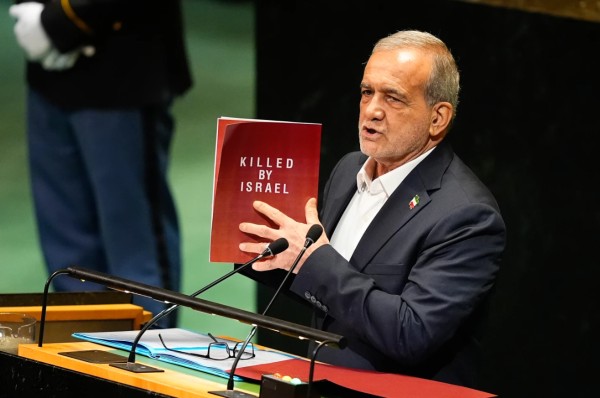
Iran President Masuod Pezeshkian holds up a book while speaking during the 80th United Nations General Assembly, Wednesday, Sept, 24, 2025.
Iranian President Masoud Pezeshkian strongly criticized the United States and Israel at the United Nations General Assembly. He accused both nations of inflicting a “grievous blow” to peace efforts. His remarks came as Iran braces for the reinstatement of sanctions, with the deadline just days away.
The president’s speech was his first major address since the 12-day Israel-Iran conflict earlier this summer. That war killed several senior Iranian leaders and collapsed ongoing talks with Washington. Hours before his address, Iran’s currency hit a historic low, reflecting deepening economic distress.
Iran Condemns Attacks at the UN
Pezeshkian told world leaders that Iran had faced “savage aggression” in June. He claimed the attacks violated basic international law. The president, considered a moderate voice in Iranian politics, used the platform to defend his country’s position.
His trip to New York aimed at saving fragile diplomacy with European nations. But those efforts were overshadowed even before his arrival. Iran’s Supreme Leader Ayatollah Ali Khamenei firmly rejected direct nuclear talks with the United States.
“The U.S. has already dictated the outcome,” Khamenei declared. “That is not negotiation. It is an imposition.”
Sanctions Deadline Approaches
France, Germany, and the United Kingdom triggered the “snapback mechanism” over Iran’s noncompliance with the 2015 nuclear deal. This process makes sanctions almost impossible to veto at the UN. Unless a last-minute agreement is reached, sanctions will return on Sunday.
The West has offered Iran more time if it agrees to resume direct nuclear talks with Washington. They also demand access for UN inspectors and a clear account of Iran’s uranium stockpile. Iran currently enriches uranium to 60%, just below weapons-grade, without having a declared weapons program.
European diplomats in New York reported little progress during talks with Iran’s Foreign Minister Abbas Araghchi. “No new results emerged,” one diplomat said, signaling that sanctions are likely to be reinstated.
Iran Accuses Europe of Bad Faith
Pezeshkian also directed criticism toward European powers. He accused France, Germany, and Britain of failing to uphold their commitments. According to him, these nations portrayed Iran’s efforts as inadequate while ignoring U.S. withdrawal from the 2015 deal.
“They operated in bad faith for years,” he argued. “They disparaged Iran’s sincere efforts as insufficient.”
If sanctions return, Tehran will again face frozen assets abroad, restrictions on arms deals, and penalties on missile development. These measures will deepen Iran’s already fragile economic situation.
Nuclear Tensions Persist
Despite global concern, Iran continues to stress that its nuclear program is peaceful. Earlier this month, it reached a limited agreement with the UN’s nuclear watchdog, mediated by Egypt, to restart cooperation. However, the deal has not yet been fully implemented.
In July, Pezeshkian approved a law suspending all cooperation with the International Atomic Energy Agency. The decision followed Israel’s bombing of nuclear sites during the June conflict.
While the West suspects Iran once pursued nuclear weapons, Khamenei insists Tehran is not seeking atomic arms. “Science cannot be demolished by threats or bombing,” he added.
Iran’s Economy Under Pressure
Beyond diplomacy, Iran faces mounting financial turmoil. The rial fell to a record 1,074,000 against the U.S. dollar on Wednesday. For comparison, when Iran signed the 2015 deal, the rate was just 32,000 per dollar.
Years of sanctions, corruption, and mismanagement have devastated Iran’s economy. The June war even forced temporary closure of Tehran’s stock market and currency exchanges.
Economic pressures have triggered unrest before. In 2019, protests erupted across nearly 100 cities after fuel price hikes. Demonstrators torched banks and gas stations in anger.
With sanctions looming, Iran now faces an even sharper financial squeeze. The coming days will determine whether last-minute diplomacy can avert a fresh round of economic isolation.