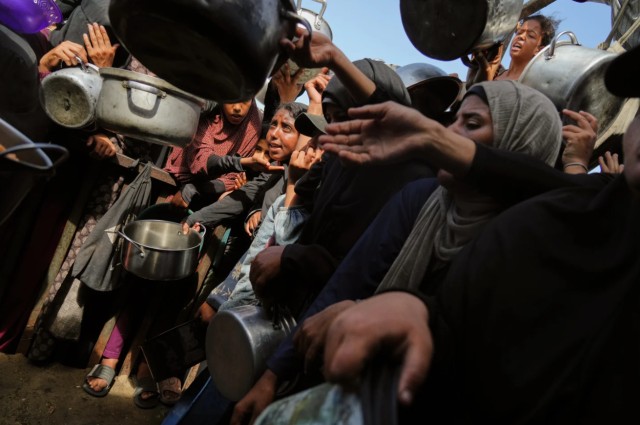
Palestinians struggle to get donated food at a community kitchen in Khan Younis, southern Gaza Strip, Sunday, Oct. 5, 2025.
The United Nations is prepared to launch one of its largest humanitarian operations in recent years. Over 170,000 metric tons of food, medicine, and essential supplies are ready to move into Gaza. However, the UN awaits a crucial green light from Israel before scaling up relief efforts for more than two million Palestinians trapped in the war-torn territory.
UN Ready to Act After Ceasefire Deal
Following the recent ceasefire deal, UN humanitarian chief Tom Fletcher said the organization is fully prepared to deliver aid “at scale.” Over the past several months, the UN and its partners have only managed to provide 20% of Gaza’s actual needs, as continuous fighting and border restrictions crippled supply routes.
“Given the level of misery and starvation, we’re mobilized for a massive collective effort,” Fletcher said. “We are absolutely ready to roll.”
The ceasefire — announced by U.S. President Donald Trump — marks the first glimmer of hope for UN officials after months of halted operations and deteriorating conditions.
Gaza’s Humanitarian Crisis Deepens
The war that began after the Hamas-led attack on Israel on October 7, 2023, which killed 1,200 people, has left tens of thousands of Palestinians dead and devastated Gaza’s infrastructure. The conflict also pushed Israel into growing diplomatic isolation as hunger, displacement, and destruction escalated across the region.
The UN said it has been repeatedly pleading for access to deliver life-saving aid. “We’ve been asking, demanding, imploring for entry — and we hope that in the coming days we will have it,” Fletcher stated during a virtual briefing from Riyadh.
Israel’s Accusations and UN’s Response
Israel has accused Hamas of diverting aid supplies, although no substantial evidence has been provided. It also criticized UN agencies for inefficiency and, in May, replaced the UN’s primary aid role with a new contractor — the Gaza Humanitarian Foundation (GHF) — supported by the U.S. and Israel.
However, UN spokesman Stephane Dujarric clarified that the GHF has no defined role under the current ceasefire terms. The UN will continue to lead the humanitarian response based on the U.S.-backed 20-point ceasefire plan, which emphasizes the UN’s central role in aid distribution.
UN’s Ceasefire Action Plan for Gaza
During the first 60 days of the ceasefire, the UN plans a massive scale-up of operations:
- 500–600 aid trucks entering Gaza daily.
- Food support for 2.1 million people and nutritional aid for 500,000 more.
- Distribution of special rations to reverse famine conditions.
- Support for bakeries and community kitchens to provide local food options.
Fletcher also highlighted plans to rebuild Gaza’s shattered health system, providing medicine, mental health services, and emergency care. The UN will also facilitate medical evacuations and deploy more emergency teams on the ground.
Rebuilding Lives and Infrastructure
Beyond immediate relief, the UN’s focus extends to restoring essential services. Plans include repairing the water grid and sanitation systems, fixing sewage leaks, and removing solid waste from residential areas.
Ahead of the approaching winter, the UN intends to deliver thousands of tents and waterproof tarpaulins weekly to provide shelter to displaced families. Education, too, remains a top priority — with efforts to reopen temporary learning spaces for 700,000 children and distribute school materials.
Appeal for Global Support
Fletcher emphasized that the 170,000 tons of aid ready at the border are only “the tip of the iceberg.” The UN requires more funding and cooperation to sustain operations and ensure civilian protection, especially for women and girls who have faced extreme violence during the conflict.
He called on the global community to act swiftly:
“Every government, every state, every individual who has asked, ‘What can we do?’ — now is the time. Your generosity can help end the suffering and rebuild hope for Gaza’s people.”