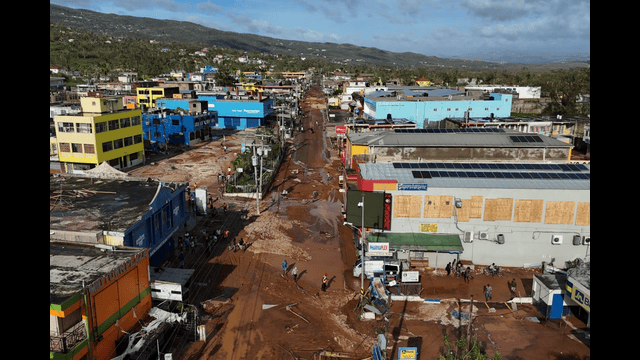
Residents walk through Santa Cruz, Jamaica, Wednesday, Oct. 29, 2025, after Hurricane Melissa passed.
Hurricane Melissa has unleashed destruction across the Caribbean, slamming areas already vulnerable to landslides and flash floods. Experts warn that decades of deforestation have made the region more prone to disaster, and the risks are expected to persist for several days as rain continues to fall.
Deforestation Deepens the Disaster
Environmental experts say deforestation has stripped the land of natural protection. The loss of trees and vegetation — which help anchor soil and slow water runoff — has intensified the impact of Hurricane Melissa. Construction of roads in once-forested areas has also worsened soil instability, leaving communities exposed to landslides and flash floods.
“The situation is still chaotic on the ground,” said Nicole Leotaud, Executive Director of the Caribbean Natural Resources Institute. She added that her team has lost contact with partners in western Jamaica, the region most affected by the Category 5 hurricane. “I think it’s going to be devastating,” she said, noting that even moderate rains have triggered frequent landslides in recent years.
Jamaica Faces Widespread Damage
In Jamaica, the full scale of destruction remains unclear. The storm brought sustained winds of 185 mph (298 kph) and dumped more than three feet (0.9 meters) of rain, leaving much of the island paralyzed. Power outages hit 77% of the country, and over 25,000 residents took shelter in emergency centers as roofs were torn off and major roads blocked.
In St. Elizabeth parish, a landslide cut off the main road in Santa Cruz, while strong winds ripped part of the roof from a high school serving as a shelter. Authorities confirmed four deaths in southwest Jamaica, though officials fear the toll could rise.
“The devastation is enormous,” said Transportation Minister Daryl Vaz, as crews and residents worked tirelessly to clear debris and reconnect isolated communities.
Cuba Struggles to Recover
Across the sea in Cuba, emergency teams used heavy machinery to reopen blocked roads. Military personnel joined rescue operations, helping people trapped in mountainous regions where landslides remain a major threat.
Jamaica’s Growing Landslide Crisis
Experts warn that Jamaica’s geography makes it one of the most landslide-prone islands in the Caribbean. Nearly half of the country is at high risk, while 30% faces very high risk due to steep terrain, volcanic soil, and frequent seismic activity.
Between 2001 and 2024, Jamaica lost 7.4% of its tree cover, largely to agricultural expansion, according to Global Forest Watch. About 20% of that loss involved humid primary forests, which are the island’s most mature and resilient ecosystems. “Once old-growth forests disappear, they take generations to recover,” said Elizabeth Goldman, Co-director of Global Forest Watch.
Floods Turning Deadlier
The disappearance of vegetation near rivers and streams has made floods “flashier,” experts say — meaning they move faster and leave little time for evacuation. “People aren’t able to get out fast enough. That is extremely dangerous,” explained Maria Uriarte, professor of ecology at Columbia University.
Climate Change Supercharges Hurricanes
Climate scientists believe global warming is amplifying hurricanes like Melissa. A warmer atmosphere retains more moisture, while rising ocean temperatures feed stronger storms. Some parts of the ocean beneath Hurricane Melissa were reportedly 2°C warmer than the seasonal average, allowing the storm to intensify with alarming speed.
But even without hurricanes, Caribbean nations face increasing vulnerability. Patterns of heavy rainfall followed by drought are weakening the land and making floods and landslides more frequent, said Leotaud.
“It’s becoming common to see flooding even with a little rain,” she warned. “Every hurricane season, people across the region are fearful. The trauma is constant.”
A Region on Edge
As the Caribbean braces for more storms in a changing climate, the message from experts is clear: deforestation is turning natural disasters into human catastrophes. Without urgent efforts to restore forest cover and strengthen infrastructure, the region’s vulnerability will only grow.
Hurricane Melissa has once again shown how climate change and environmental neglect can combine to devastating effect — a warning that the Caribbean cannot afford to ignore.