Postdoctoral research fellow at The Johns Hopkins University School of Medicine Finds First Imaging Marker That Reveals Chronic Stress
Researchers say they have identified the first objective biomarker of chronic stress that can be detected through routine chest CT scans, opening a potential new window into how long-term stress affects the body.
The findings, presented earlier this month at the annual meeting of the Radiological Society of North America, rely on artificial intelligence to extract biological signals that were previously difficult to measure.
Turning Routine Scans Into Stress Indicators
The research team used a deep learning model to analyze standard chest CT images. Their focus was the adrenal glands, small organs that play a key role in the body’s stress response by producing cortisol.
While cortisol blood tests exist, they only capture stress at a single moment. The researchers wanted to see whether adrenal gland size could reflect stress accumulated over time.
“There is no widely accessible marker that measures chronic stress in medical imaging,” said lead author Elena Ghotbi, a postdoctoral fellow at Johns Hopkins University School of Medicine.
That gap motivated the team to test whether adrenal gland volume could serve as a biological indicator of prolonged stress.
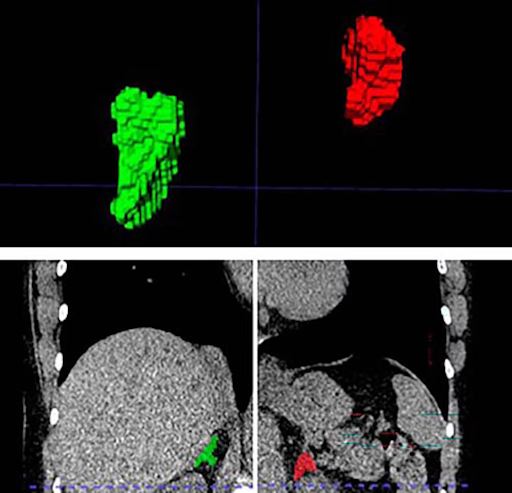
Left and right adrenal automated 2D and 3D segmentation in chest CT. (Credit: Elena Ghotbi, M.D., and RSNA)
Measuring Stress Through Adrenal Volume
Using AI, the model automatically identified and measured the adrenal glands on CT scans. From this, researchers calculated an Adrenal Volume Index, or AVI.
The AVI was defined as the total adrenal gland volume divided by a person’s height squared. This adjustment helped account for differences in body size.
When researchers compared the results with patient data, a pattern emerged. People who reported higher levels of perceived stress consistently had higher AVI scores.
Strong Links To Hormones And Heart Health
The model was tested on nearly 3,000 participants from the Multi-Ethnic Study of Atherosclerosis, a long-running cohort that includes CT scans, cortisol measurements, and health outcomes.
According to Ghotbi, the adrenal volume measurements were associated with multiple indicators.
“We were able to show that adrenal volumes were linked to cortisol levels, self-reported stress, and long-term cardiovascular outcomes,” she said.
Those findings suggest adrenal gland enlargement may reflect the cumulative biological impact of chronic stress.

Stress is linked to a range of physical and mental health problems, including heart disease, and a weakened immune system. CTV News
Why Chronic Stress Matters
Health authorities have long warned that stress contributes to serious health problems. Health Canada links chronic stress to heart disease, weakened immunity, mental illness, and some gastrointestinal conditions.
Despite that, clinicians lack an objective and standardized way to measure its long-term effects.
Senior author Shadpour Demehri, a professor of radiology at Johns Hopkins, said the study aims to fill that gap.
“There is no quick or objective measure of chronic stress,” he said. “We are less focused on the psychological experience and more on the biological impact.”
A New Use For Existing Medical Data
One of the most promising aspects of the research is its practicality. The AI algorithm can be applied to CT scans that are already being performed for other medical reasons.
That means stress-related insights could be extracted without additional tests, costs, or radiation exposure.
In Canada alone, about 6.4 million publicly funded CT scans were performed in the 2022–2023 fiscal year. That translates to roughly 160 scans per 1,000 people.
Demehri said the scale of existing imaging data makes the approach particularly powerful.
“Just imagine this algorithm running on CT machines everywhere and extracting this information,” he said.
Early Findings, Cautious Optimism
Both researchers stressed that the results are preliminary. The model must be validated across different populations, scanners, and age groups before it can be used in clinical settings.
External validation will be critical to confirm that the findings are consistent and reliable.
Still, the study highlights how artificial intelligence can uncover hidden biological signals in everyday medical images.
“There’s nothing guaranteed in medicine,” Demehri said. “But we are very hopeful.”
If validated, the technique could eventually help doctors identify patients at higher risk of stress-related disease, long before symptoms appear.