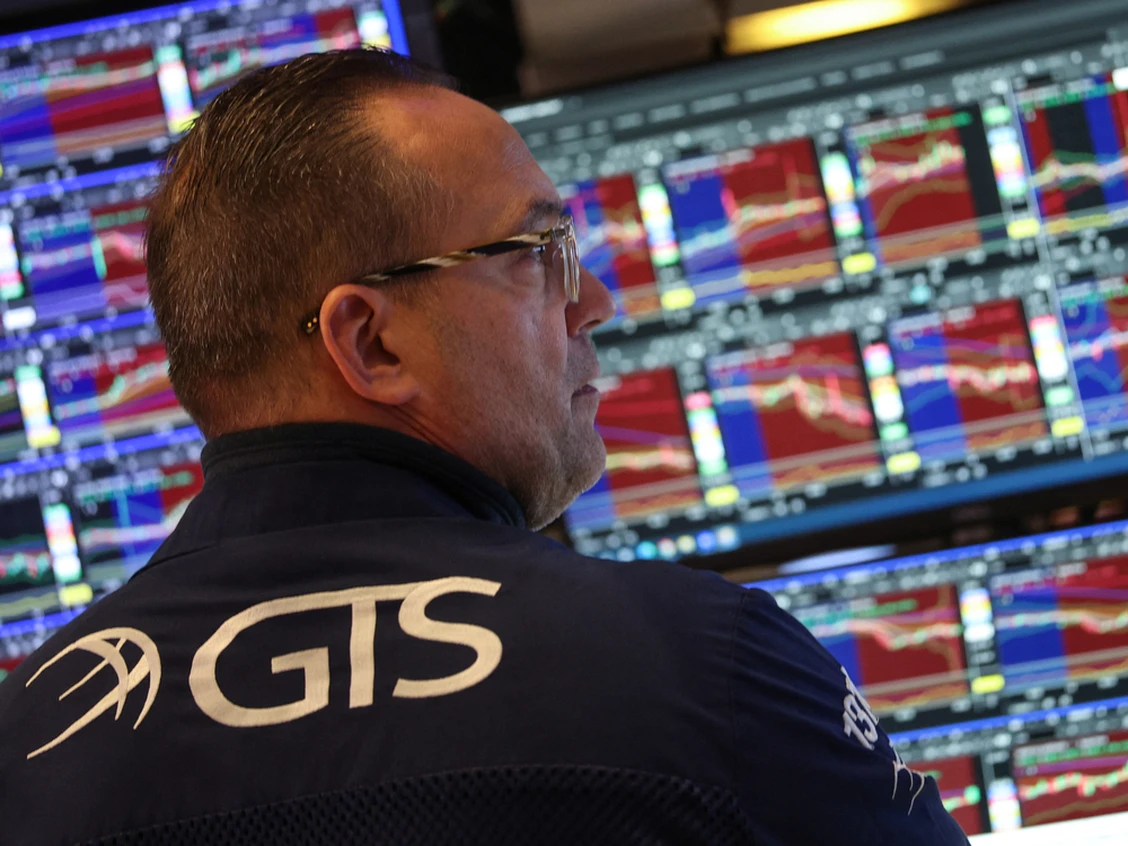
A trader works at his desk on the floor of the New York Stock Exchange (NYSE) in New York on January 14, 2026. Getty Images
Global investors are preparing for a volatile 2026 as the White House advances what analysts have dubbed the “Donroe Doctrine” — a revival of U.S. foreign policy focused on asserting dominance across the Western Hemisphere, with ripple effects expected across global markets.
The Trump administration formally outlined the strategy in a national security document released last month, signalling a more assertive geopolitical stance that investors say could influence everything from technology supply chains to defence spending and commodity prices.
While U.S. equities have so far shrugged off recent geopolitical shocks — including the ouster of Venezuela’s former president Nicolás Maduro — market participants caution that underlying risks are building.
Technology Faces Supply Chain Risks
Technology stocks, which carry the largest weight in U.S. equity indices, are seen as especially vulnerable if tensions escalate between Washington and Beijing.
Investors are closely watching Taiwan, a critical hub for semiconductor manufacturing. Major U.S. firms rely heavily on Taiwanese suppliers, and any disruption could have severe consequences for global chip availability and valuations.
“If Taiwan were suddenly destabilized, the implications for U.S. markets would be enormous,” one portfolio manager said, noting that semiconductors now account for a significant share of the S&P 500.
At the same time, companies tied to domestic chip production and Pentagon contracts could benefit if supply chains are forced to shift closer to home.
Defence Stocks Gain Favour
Defence stocks have emerged as early beneficiaries of rising geopolitical uncertainty. Expectations of increased military spending and a more confrontational global posture have lifted shares of major U.S. defence contractors early in the year.
Market strategists say defence names could continue to serve as a hedge if global tensions persist.
“In an environment that feels structurally less stable, defence becomes a natural rotation for investors,” said one asset manager.
Energy Markets React to Iran, Venezuela Signals
Oil prices have already shown sensitivity to Washington’s rhetoric, climbing after renewed warnings directed at Iran. However, scepticism remains around the administration’s ambition to rapidly revive Venezuela’s oil sector.
Energy analysts caution that reopening production in Venezuela would take time and significant investment, tempering expectations for immediate gains among oil producers.
Refiners, particularly along the U.S. Gulf Coast, are viewed as potential beneficiaries if global supply expands and crude prices remain under pressure.
Metals and Safe Havens Attract Interest
The materials sector has also seen sharp moves, particularly among companies linked to rare earths and critical minerals. Speculation around Greenland’s strategic importance has fueled rallies, though analysts warn of volatility if diplomatic tensions escalate further.
Meanwhile, gold and silver prices have climbed to new highs, reflecting growing investor demand for hedges against geopolitical instability.
“The world is not getting any safer,” one strategist said. “Markets are starting to price that in.”
As 2026 unfolds, investors say the challenge will be navigating a landscape where geopolitical decisions — often unpredictable — increasingly shape financial outcomes.