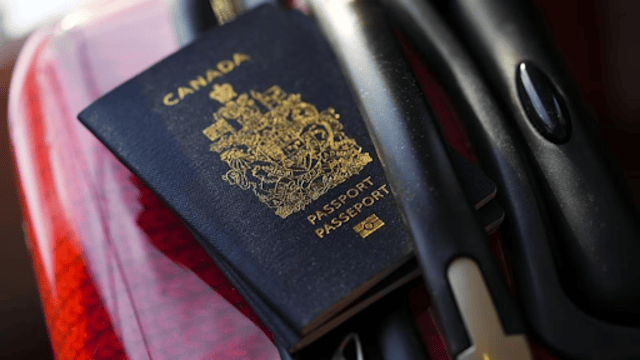
A Canadian passport sits on a suitcase in Ottawa on Tuesday, Jan. 17, 2023.
Canada’s passport continues to be one of the world’s most powerful travel documents.
In 2026, it ranks eighth globally on the Henley Passport Index.
The ranking places Canada ahead of the United States and alongside Iceland and Lithuania.
Holders of a Canada passport can access 181 countries visa-free or with visa-on-arrival privileges.
Yet, experts say the Canada passport ranking does not reveal the full picture.
While the number signals strong global mobility, it measures only one aspect of international freedom.
Rights to live, work, or settle abroad remain outside the index’s scope.
How the World’s Strongest Passport Rankings Are Calculated
The Henley Passport Index is compiled by Henley & Partners, a London-based advisory firm.
It relies on data from the International Air Transport Association.
That database tracks visa rules across 227 countries and territories worldwide.
The index focuses purely on visa access.
Each destination counts if entry is visa-free or allows visas on arrival.
No weight is given to work permits, residency rights, or long-term settlement options.
According to Henley & Partners, the calculation is intentionally simple.
The Canada passport score reflects how many countries Canadians can enter without advance paperwork.
Visa-on-arrival destinations count the same as visa-free access in the final tally.
The difference between the two is procedural.
Visa-free entry requires no application at the border.
Visa-on-arrival involves filling out documents after landing.
Why Passport Power Does Not Equal Total Mobility
Migration experts caution against reading passport rankings too literally.
They argue the list reflects policies set by wealthy nations.
Richer countries tend to grant easier access to fellow wealthy states.
As a result, global rankings often mirror economic divides.
Countries with strong economies usually top the passport power charts.
Poorer nations remain clustered at the bottom.
More importantly, the index ignores where people can legally live or work.
That omission matters for long-term mobility.
European Union passports offer a clear advantage here.
EU citizens can live and work freely across 27 member states.
This right is not reflected in simple visa counts.
By comparison, non-EU passports lack similar regional privileges.
Canada Passport Strengths and Its Recent Slippage
Canadians often view their passport as elite.
Historically, that belief had strong backing.
In 2014, the Canada passport ranked second globally.
Over the past decade, its position has slipped slightly.
Despite that, Canada has remained inside the global top ten.
Growing competition has reshaped the rankings.
European and Asian countries have expanded visa-free access aggressively.
Many pursued bilateral travel agreements with strategic focus.
Canada has moved more cautiously by comparison.
Canada also allows visa-free entry to fewer foreign nationals.
Reciprocity plays a role in passport power.
Countries granting easier access often receive the same treatment in return.
High visa fees further complicate the picture.
For wealthier travelers, costs are minor inconveniences.
For students or young professionals, they can be restrictive.
Can Canada Improve Its Passport Ranking?
Experts say improvement is possible with policy shifts.
Reducing visa requirements would have immediate effects.
Expanding “safe country of origin” lists could help.
Such steps would boost reciprocity.
They would also strengthen Canada passport mobility.
Policy change, however, requires political will.
For now, Canada holds a strong but not dominant position.
It remains a “good passport,” though not the strongest globally.
Where Other Countries Stand in 2026
Asian passports lead the 2026 rankings once again.
Singapore holds first place with access to 192 destinations.
Japan and South Korea share second place with 188 destinations.
Europe dominates the upper tiers.
Five European nations share third place with 186 destinations.
Another ten European countries follow closely with 185 destinations.
The United Arab Emirates continues its rapid rise.
It shares fifth place after climbing 57 positions since 2006.
Diplomacy and visa liberalization drove this surge.
Canada’s eighth-place rank comes amid declines elsewhere.
The United Kingdom has lost significant visa-free access.
The United States ranks tenth with 179 destinations.
At the bottom, Afghanistan remains last with access to just 24 countries.
The gap between the strongest and weakest passports now spans 168 destinations.
Despite these divides, passport power remains dynamic.
More countries are investing in mobility through diplomacy.
For Canada, the passport remains strong, even if the story is more layered.