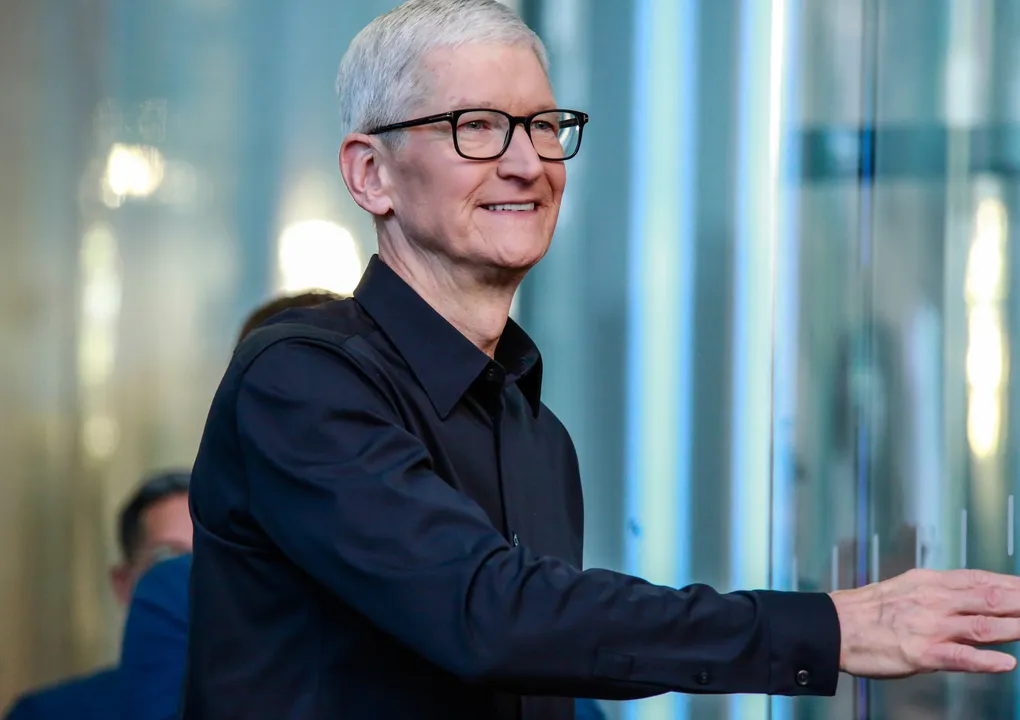
Tim Cook is stepping down as CEO of Apple after nearly 15 years. He will remain with the company as executive chairman. (Photo Credit: Bloomberg)
Apple is preparing for a major leadership transition as Tim Cook steps down from his role as chief executive officer after nearly 15 years at the helm. The move marks the end of an era that saw the company’s valuation surge dramatically, driven largely by the continued success of the iPhone and its broader ecosystem.
Cook will hand over leadership responsibilities to John Ternus, Apple’s head of hardware engineering, on September 1. While stepping away from day-to-day operations, Cook will remain closely involved with the company as executive chairman, ensuring continuity during the transition.
A Leadership Shift After a Long Tenure
Tim Cook assumed the role of CEO in 2011, following the passing of Apple co-founder Steve Jobs. At the time, the transition raised questions about whether the company could maintain its momentum without its visionary leader.
Over the years, Cook guided Apple through a period of sustained growth, transforming it into one of the most valuable companies in the world. During his tenure, Apple became the first publicly traded company to reach market valuations of $1 trillion, $2 trillion, and $3 trillion, eventually climbing to around $4 trillion.
Despite this financial success, Cook’s leadership has often been viewed through the lens of comparison with Jobs, particularly in terms of groundbreaking innovation.
John Ternus Steps Into the Role
John Ternus, who will take over as CEO, has been with Apple for more than 25 years and has played a central role in shaping its core products. Over the past five years, he has overseen the engineering behind key devices such as the iPhone, iPad, and Mac.
His deep involvement in Apple’s hardware development positioned him as a leading candidate for succession. The transition signals a continued focus on product engineering, particularly as the company navigates new technological challenges.
Ternus is expected to outline his vision further when Apple releases its quarterly financial results later this month.
A Critical Moment for Apple
The leadership change comes at a time when the technology industry is undergoing significant transformation, largely driven by advances in artificial intelligence.
Apple has faced criticism for being slower than some competitors in integrating AI into its products. After delays in delivering promised features, the company recently turned to external partnerships to strengthen its capabilities, including working with Google to enhance its virtual assistant.
This shift highlights the growing importance of AI in shaping the next phase of innovation, making the timing of the leadership transition particularly significant.
Cook’s Legacy: Growth and Stability
Tim Cook’s tenure is defined by operational excellence and financial expansion. He strengthened Apple’s global supply chain, expanded its services business, and maintained the company’s dominance in consumer electronics.
Revenue grew substantially during his leadership, rising from approximately $108 billion in 2011 to over $400 billion annually. His expertise in supply chain management also played a crucial role in scaling production and navigating complex international manufacturing networks.
At the same time, Cook introduced new product categories, including the Apple Watch and AirPods, which became commercially successful even if they did not match the transformative impact of earlier innovations like the iPhone.
Innovation Versus Execution
One of the recurring debates during Cook’s tenure has been the balance between innovation and execution. While Apple continued to grow steadily, critics argued that it did not deliver a single breakthrough product that redefined the industry in the same way as the iPhone.
Projects such as a self-driving car initiative were eventually shelved, reinforcing perceptions that the company had become more cautious in pursuing high-risk innovations.
However, analysts widely acknowledge that maintaining Apple’s scale and consistency required a different kind of leadership, focused on efficiency, resilience, and long-term stability.
Navigating Political and Economic Challenges
Cook also played a key role in managing Apple’s relationships with global governments, particularly in the context of trade tensions between the United States and China.
By adjusting manufacturing strategies and diversifying production to countries like India, Apple was able to mitigate the impact of tariffs and maintain supply chain efficiency. These decisions helped protect the company’s margins while ensuring continued product availability.
What Lies Ahead for Apple
As John Ternus takes over, the focus is likely to shift toward defining Apple’s next phase of innovation, especially in artificial intelligence and emerging technologies.
The transition reflects a broader industry trend where companies are balancing legacy strengths with the need to adapt to rapidly changing technological landscapes.
For Apple, the challenge will be to build on its strong foundation while identifying the next wave of transformative products that can sustain its leadership position.