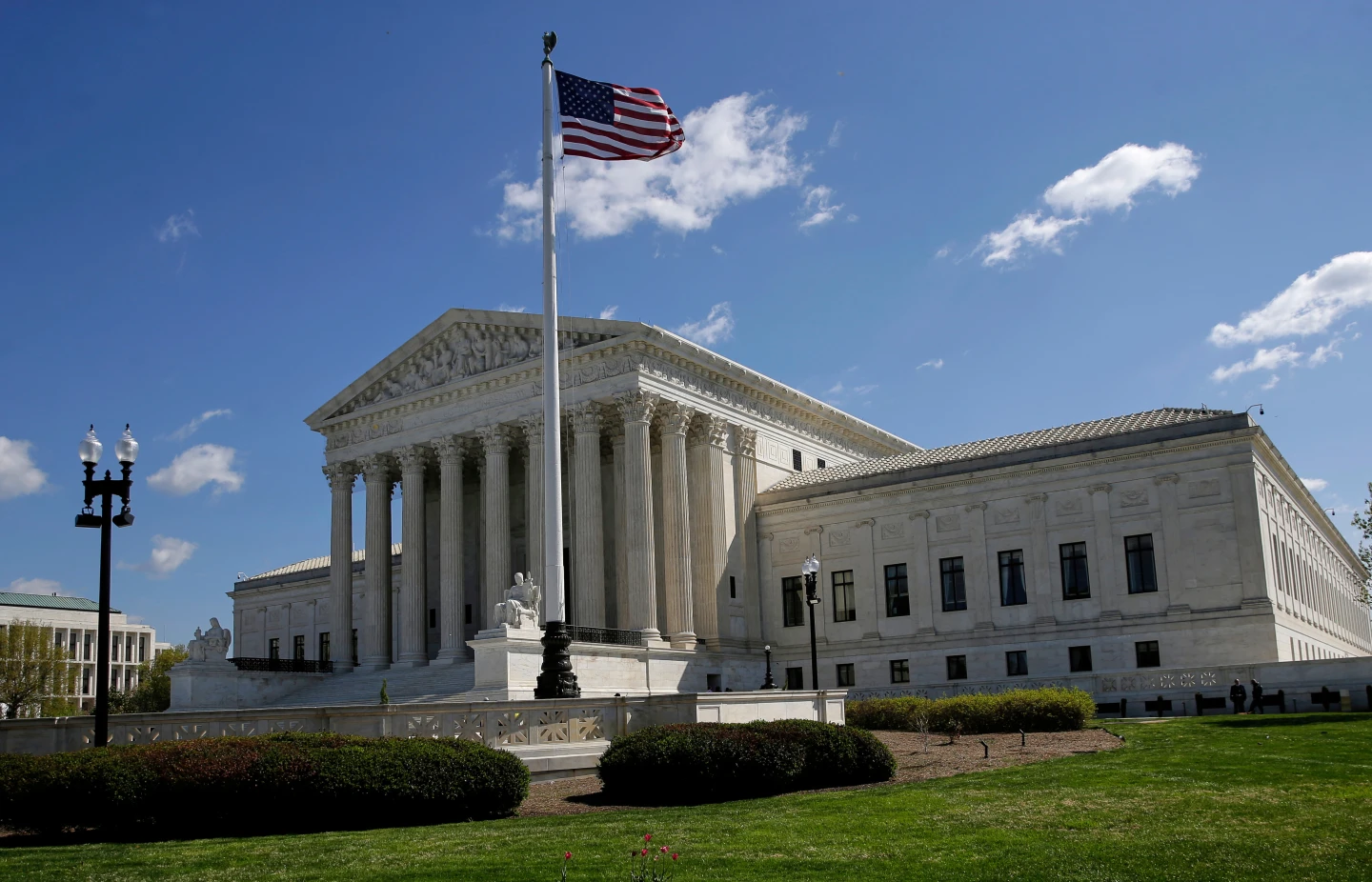
The U.S. Supreme Court is seen in Washington, Tuesday, April 7, 2026, in Washington.
The Supreme Court has struck down Louisiana’s second majority Black congressional district, delivering a major ruling that could reshape redistricting battles across the United States. The decision is expected to influence how states draw electoral maps and may carry significant political consequences ahead of future congressional elections.
The 6-3 ruling centered on a Louisiana map that created two majority Black districts out of the state’s six congressional seats. The court’s conservative majority concluded that race played too large a role in designing the district, making it unconstitutional under their interpretation of existing legal standards.
Louisiana Congressional District Decision Carries National Impact
The Louisiana congressional district case reaches far beyond one state’s borders. Legal analysts say the ruling could encourage Republican-led states to challenge or redraw minority-majority districts that often favor Democratic candidates.
Because many similar districts across the country were shaped under protections in the Voting Rights Act, the decision may trigger renewed disputes over whether race can be considered when protecting minority voting strength. That uncertainty could affect congressional representation in multiple states.
The ruling also arrives during a politically sensitive period, as parties prepare for the 2026 midterm elections. With control of the House often determined by a small number of seats, even limited map changes could shift the balance of power.
Voting Rights Act Protections Face New Questions
At the heart of the case is Section 2 of the Voting Rights Act, a landmark civil rights provision used to challenge discriminatory voting practices. For decades, it has served as one of the most important legal tools for minority communities seeking fair political representation.
The court’s majority signaled a narrower interpretation of that protection, suggesting that race-based remedies should be limited and carefully scrutinized. Critics argue this approach weakens one of the country’s most significant voting rights safeguards.
Dissenting justices warned that the decision could make it far more difficult to challenge district maps that dilute minority voting power. They said the consequences may be widespread and long-lasting.
Louisiana Congressional District Map Followed Earlier Court Guidance
The disputed Louisiana congressional district was created after a previous Supreme Court ruling involving Alabama, where the justices required fairer representation for Black voters. That earlier decision prompted Louisiana lawmakers to adopt a second majority Black district, reflecting the state’s sizable Black population.
Louisiana’s demographics played a central role in the debate. Roughly one-third of the state’s residents are Black, and supporters of the map argued that two majority Black districts more accurately reflected the population.
However, the court’s latest ruling marks a shift from that earlier approach, adding uncertainty to how states should balance demographics, geography, and race in future maps.
Political Fallout Already Emerging
The Louisiana congressional district ruling was released as lawmakers in Florida debated new congressional boundaries that could strengthen Republican chances in that state. The timing immediately intensified partisan battles over redistricting nationwide.
Republicans in several states may now view the decision as an opportunity to pursue more aggressive map changes. Democrats, meanwhile, are likely to challenge those efforts and frame the ruling as a setback for minority representation.
Redistricting disputes have become increasingly central to modern elections, especially after earlier court rulings allowed highly partisan maps to remain in place.
Future of Representation Remains Unclear
The Louisiana congressional district decision is likely to generate further lawsuits as states test the boundaries of the ruling. Courts may soon face new cases involving Black and Latino districts, especially in fast-growing or politically competitive states.
For now, the judgment stands as one of the most consequential election law decisions in recent years. It not only reshapes Louisiana’s political map but also redefines the national debate over race, fairness, and representation in American democracy.